
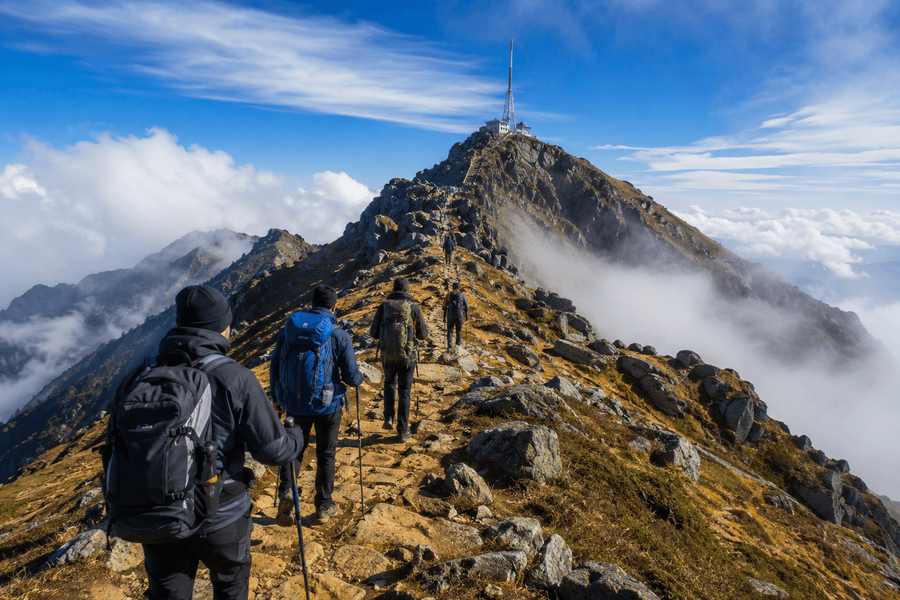
Trekking to the summit of Churdhar feels like leaving the civilized world entirely behind to touch the sky. The moment you navigate past the alpine meadows and tackle the final, jagged boulder fields to reach the towering Shiva idol at the 11,965-foot summit, it hits differently. It is not a casual weekend stroll. It is a deeply spiritual, raw, and physically demanding pilgrimage that commands absolute respect for the mountains.
What makes it so incredibly fascinating is the dramatic isolation. As the absolute highest peak in the outside Shivalik range, the summit stands completely unblocked by any other mountains. When you finally pull yourself onto the freezing, wind-whipped top, you are rewarded with an unbelievable 360-degree panorama that includes the distant, snow-capped giants of Badrinath and Kedarnath. Sitting by the ancient Shri Shirgul Maharaj temple right below the peak, watching the clouds literally form beneath your feet, makes the grueling climb entirely worth the pain.
One fun fact people love:
Because of its unparalleled, dominating height over the region, the legendary surveyor Sir George Everest actually used this exact peak as a massive triangulation station in the 19th century to accurately map the Himalayan mountains.
Where in Nahan is it?
The trek base camp is located at Nohradhar, which is situated about 65 kilometers deep into the Sirmaur district from Nahan town.
How to reach:
You absolutely need a private cab or a local bus to drive from Nahan to the Nohradhar base camp, which takes about 2.5 hours. From there, you must hike.
Strongly avoid starting your uphill trek any later than 10:00 AM, as the 16-kilometer ascent requires a full day of daylight to safely reach the temple accommodations.
Best time to visit:
May to June and September to November, without question. The trail is completely buried under several feet of highly dangerous snow during the winter, and monsoon rains cause deadly landslides.
Best time of day:
Start your ascent either:
Early morning around 6:00 AM
or
Break the trek by camping halfway up at the Gujjar huts.
The weather at the summit turns violently stormy almost every single afternoon, making early morning summits mandatory.
Entry fee:
There is no official entry ticket, but renting a basic blanket and floor space at the temple dharamshala (ashram) at the top costs a very nominal fee of a few hundred rupees.
Commute difficulty:
Very High. You need a long vehicle ride to the base, followed by a punishing, 16-kilometer, steep uphill trek that rapidly gains thousands of feet in elevation.
Things nobody tells you about this place:
- The altitude sickness is absolutely real.
- Because the elevation gain from the base to the summit is so incredibly rapid, you will feel dizzy and breathless if you do not pace yourself and drink massive amounts of water.
- Combine it with an ashram stay.
- This is the real hack. Do not try to rush up and down in one day. Pair the brutal climb with an overnight stay sleeping on the floor of the temple ashram, eating simple, hot langar (community meal) with the pilgrims.
- Water sources are incredibly scarce.
- A lot of people expect streams everywhere. Remember, for the last 5 kilometers of the steep ascent, there is absolutely zero running water. You must carry at least two liters per person.
- The descent will destroy your knees.
- Walking 16 kilometers steeply downhill the next day is agonizing on the joints, making a pair of sturdy trekking poles an absolute necessity for this journey.