
Shanti Stupa
About
Perched atop Chanspa Hill overlooking Leh, Shanti Stupa is one of the most recognizable landmarks in Ladakh and among the most visited attractions in the region. Built in 1991 by Japanese Buddhist monks and local Ladakhi Buddhists, the white-domed stupa was created to promote world peace, prosperity, and harmony while strengthening cultural ties between Japan and India. Standing at an elevation of over 3,600 meters, the stupa dominates the skyline of Leh and can be seen from various parts of the town. Its brilliant white structure contrasts beautifully against the rugged brown mountains and deep blue Himalayan skies, making it a favorite among photographers. The stupa features beautifully crafted relief panels depicting important events from the life of Gautama Buddha, including his birth, enlightenment, and teachings. Visitors can walk around the circular prayer path, spin prayer wheels, and enjoy the peaceful atmosphere that surrounds the monument. What truly sets Shanti Stupa apart is its breathtaking viewpoint. The elevated location offers uninterrupted panoramas of Leh town, the Indus Valley, Stok Kangri, Namgyal Tsemo Monastery, and the surrounding Himalayan ranges. Whether visited at sunrise, during the day, or at sunset, the scenery is spectacular from every angle. As evening approaches, the stupa glows softly against the darkening mountains while the lights of Leh begin to twinkle below, creating one of the most memorable sights in Ladakh. For many travelers, a visit to Shanti Stupa is not just about sightseeing. It is a place to slow down, absorb the beauty of the Himalayas, and experience a rare sense of calm above the bustling streets of Leh.

Highlights
What makes this place special

Panoramic View of Leh and the Himalayas
The stupa offers one of the finest viewpoints in Ladakh, overlooking Leh town, the Indus Valley, surrounding monasteries, and snow-capped Himalayan peaks.
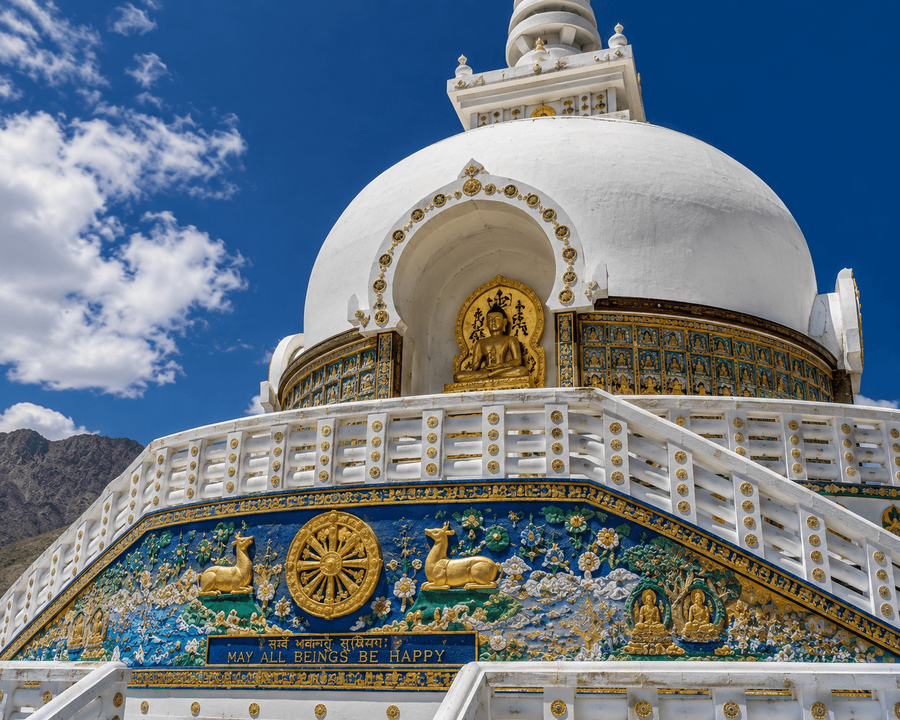
White Dome and Buddhist Relief Panels
The striking white stupa features detailed carvings and reliefs depicting key moments from the life of Buddha, making it both a spiritual and architectural landmark.

Sunrise and Sunset Experience
Golden-hour light transforms the surrounding mountains and valleys into a spectacular landscape, making Shanti Stupa one of the best photography spots in Leh.

Peaceful Prayer Walk
Visitors can walk around the stupa's circular pathway, enjoy the fluttering prayer flags, and experience the tranquil atmosphere that inspired its construction.
Things to Know
- •Built in 1991 as part of a global peace initiative led by Japanese Buddhist monk Gyomyo Nakamura.
- •Stands at an altitude of approximately 3,609 meters (11,841 feet).
- •The white-domed stupa was constructed to promote world peace and strengthen cultural ties between Japan and India.
- •Houses sacred Buddhist relics believed to have been enshrined by the 14th Dalai Lama.
- •Entry is free for all visitors.
- •Open throughout the day and accessible until evening.
- •Can be reached by road or by climbing approximately 500 steep steps from the base of the hill.
- •The staircase route offers increasingly impressive views of Leh town during the ascent.
- •Visitors who prefer to avoid the climb can reach the top directly by taxi, bike, or private vehicle.
- •Sunrise and sunset are widely considered the best times to visit.
- •The stupa is famous for offering some of the finest panoramic views in Ladakh.
- •From the summit, visitors can enjoy sweeping views of Leh town, the Indus Valley, Namgyal Tsemo Monastery, Leh Palace, Stok Kangri, and surrounding Himalayan ranges.
- •The monument is particularly beautiful at sunset when the mountains glow in shades of gold, orange, and pink.
- •Night visits are also popular as the illuminated white stupa stands out dramatically against the dark mountain backdrop.
- •The stupa features intricate relief panels depicting important events from the life of Buddha.
- •The upper circular platform provides excellent opportunities for photography.
- •Visitors can walk around the stupa on the prayer pathway while enjoying uninterrupted mountain views.
- •Prayer flags surrounding the site add color and character to the landscape.
- •Strong winds are common at the summit, especially during afternoons and evenings.
- •Carry a light jacket even during summer months.
- •Due to the altitude and stair climb, visitors should walk slowly and stay hydrated.
- •Carry water, sunscreen, sunglasses, and a hat as shade is limited at the top.
- •Early morning visits are generally quieter and less crowded.
- •The stupa attracts photographers, spiritual travelers, bikers, and tourists throughout the day.
- •The site is especially popular during full moon nights when the surrounding mountains appear particularly dramatic.
- •Photography is allowed throughout the complex.
- •Drone usage may require local permissions and should be checked beforehand.
- •Shanti Stupa is often combined with Leh Palace, Namgyal Tsemo Monastery, Hall of Fame Museum, and Leh Market as part of a half-day sightseeing itinerary.