
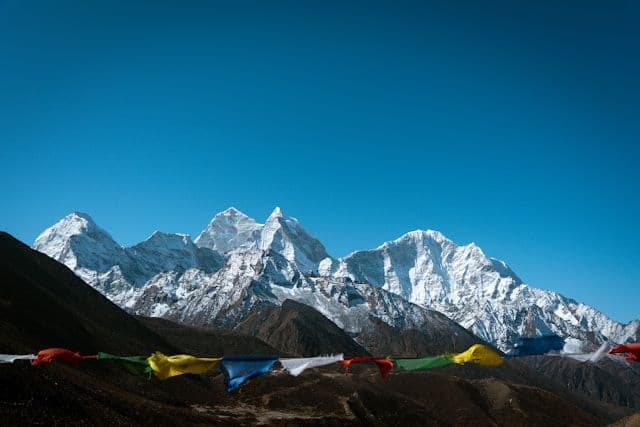
Your rear tyre slides half an inch on loose stone and a Sherpa porter walks past without looking up, while the Everest Trail drops away into blue air beside you.
Why riders fear and chase the Everest Trail
Trekkers measure this route in days and teahouses; mountain bikers measure it in heartbeats between switchbacks.
The same steps, suspension bridges and cliffside paths that carry pilgrims and yaks turn into a moving puzzle when you arrive on two wheels.
You know why this is the ultimate challenge when you notice:
- Stone steps built for boots, not pedals
- Long drop-offs with no guardrail, only prayer flags
- Thin air that makes every short climb feel twice as long
- Porters walking faster than you climb on your lowest gear
The line between “rideable” and “you are definitely carrying the bike” shifts with weather, fatigue and respect for those on foot.
Terrain that changes every few minutes
Lukla to Namche: the first test
From the airstrip at Lukla, the Everest Trail begins like a village lane.
Children in school uniforms, mani stones, low walls, smell of woodsmoke.
Then the path tilts.
Suspension bridges sway over the Dudh Kosi, stepped climbs bite into your legs, and you start to understand why the classic Everest base camp trek difficulty is rated moderate to hard, even without a bike.
Between Lukla and Namche Bazaar:
- Smooth dirt gives way to cobbled rock
- Mule trains and yaks claim right of way, always
- Short, punchy climbs pile altitude into your lungs faster than your fitness chart suggests
You ride some stretches, push others, and learn early that this is not downhill park play; it is shared infrastructure in a high mountain economy.
Above Namche: thin air and tight lines
Past Namche, forests thin and views explode.
Ama Dablam stands sharp, Everest hides then peeks from behind its neighbours, and the track narrows to a hard line scratched into the hillside.
Here, every corner demands decisions:
- Stay in the saddle and risk a pedal strike on uneven rock
- Dab a foot and reset your balance beside a long fall
- Shoulder the bike through tight, stepped sections used by monks and grandmothers
On paper, the Everest base camp trek distance from Lukla is around 65 km return.
On a bike, it feels longer, because you are fighting gravity in both directions.

Everest Base Camp trek difficulty, squared on two wheels
What trekkers do in steady rhythm, riders do in bursts.
You hammer a climb, then stop suddenly for a yak train, lungs on fire.
Add to that:
- Altitude rising above 3,500–5,000 metres
- Loose, broken stone that moves under tyres
- Cold mornings that turn streams to ice on shaded slabs
This is why serious riders often study Everest base camp trek packages even if they plan to ride, not walk.
Those itineraries show where to acclimatise, where to sleep, and how fast the body can safely climb.
For many Indian riders, a mount Everest trekking package from india is the research base, even if they later custom-build a rideable version with local Nepali outfitters.
Looking at Everest base camp trek cost from india also grounds expectations; flights, permits, porters and extra gear for a bike add up fast.
Training and preparation before you touch Nepal soil
You do not arrive cold at Lukla with a fresh bike and a new helmet.
You arrive with legs that know long climbs and a mind that has met exposure before.
Riders from the plains use hill stations as rehearsal.
The so‑called Everest base camp mussoorie route and other steep Uttarakhand trails give you a taste of stacked hairpins and rough stone, even if the air is much thicker there than in Khumbu.
Smart preparation includes:
- Back‑to‑back days of 1 000 m+ climbing at home
- Practising hike‑a‑bike on stairs and rocky paths
- Learning to fix basic mechanical issues with frozen fingers
- Packing light but warm, because every gram counts on your back or bike
By the time you face the real Everest Trail, your body should recognise the pattern of effort, even if the altitude is new.
Riding without breaking the trail’s rhythm
This path is not a bike park; it is a lifeline for villages.
The oldest rule is simple: feet and hooves first, wheels second.
Good trail manners here mean:
- Dismounting for yaks, porters and elders, not squeezing past
- Keeping speed low through villages, even if the line looks clean
- Never cutting new switchbacks or skidding for style on fragile soil
- Listening to local guides about which sections are sacred, dangerous or both
You are a guest on a route that existed long before gears and suspension, and your behaviour decides whether riders remain welcome.
Building the right kind of Everest plan
The steepest climb is not the hardest part; figuring out the logistics: flights, permits, porters, good guides, and safe places to sleep all the way up and down is.
You stitch together parts from Everest base camp trek packages, local biking operators and your own training calendar until the plan works.
When you know which nights you need in Kathmandu, where you will stop at Namche, Dingboche or the lower, and how many buffer days you can have for weather and altitude, it gets a lot easier to book the right guesthouses and city stays through Neomaxer so that your energy can be on reading clouds, rocks, and breath on the Everest Trail, not on finding a last bed at dark in the high Himalaya.









