
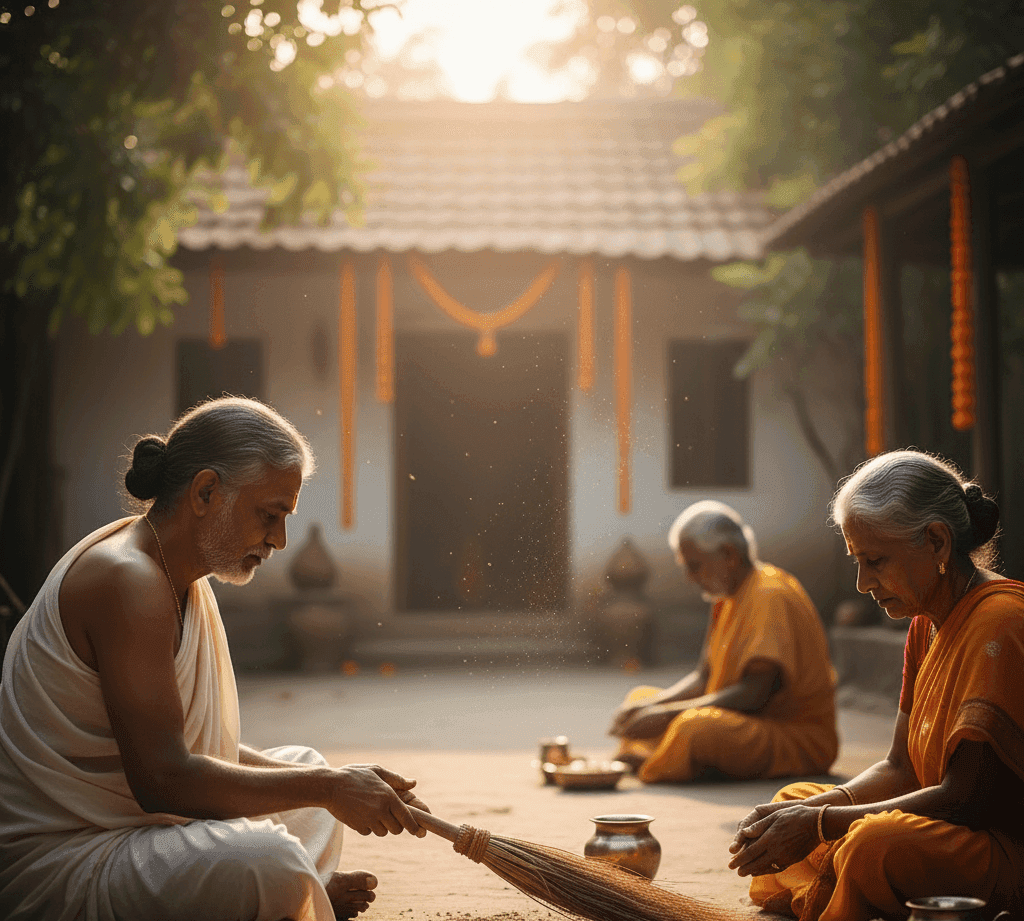
Sankranti morning begins with a rule many households still follow without question, a rule whispered more than explained. Floors stay untouched. Brooms stay leaned against the walls. People move quietly so nothing stirs the luck believed to have settled in the home overnight. Elders say prosperity arrives early, before sunrise, and sweeping at that moment sends it away before it even enters.
Where the Ritual Comes From
In the older streets of Andhra and Karnataka, the Sankranti morning ritual is treated the way forest workers treat signs on a trail. They do not argue with it. They observe it. A clean courtyard from the evening before signals respect. An untouched floor signals welcome. Women step outside before dawn to draw rangoli, never sweeping the space first. They sprinkle water with their hands instead, letting the dust settle gently. Men light small lamps near the gate so the path feels open for blessings. No one lifts a broom. No one tests the rule. People say the house carries the scent of a new harvest that morning. They say grain, luck, sunlight, and the spirit of prosperity cross the threshold together. Disturbing the floor is like stepping ahead of what is meant to arrive on its own time.
Households That Keep the Rule Alive
In Tamil Nadu, the Sankranti celebration unfolds through these tiny decisions. A grandmother taps the floor with her fingers to check for moisture rather than wiping it. A child is told to walk slowly, almost mindful of each step. Even doors are opened softly. In Maharashtra, families place small bowls of sesame and jaggery near their entrances. These bowls sit undisturbed. People believe that the sweetness carried through the house on Sankranti morning should not be pushed away. They say sweeping is not just cleaning, it is rejection. And no one rejects prosperity on a festival built around abundance. Visitors often ask during conversations about the Sankranti morning ritual why the rule still survives in modern homes. Elders answer with stories instead of explanations. Stories of years when crops failed, and people relied entirely on belief to fill the absence. Stories of mornings when a broom fell accidentally, and someone quickly muttered a prayer to undo the damage.

Food as a Sign, Not Just a Meal
The special cuisine of Makar Sankranti carries its own signals. Tilgul in Maharashtra, ellu bella in Karnataka, pongal in Tamil Nadu, and paramannam in Andhra. Each dish is assembled quietly in the early hours, stirred slowly so that sound does not ripple through the house. Families say sesame brings warmth and protection, jaggery brings sweetness to speech, and rice brings steadiness. These foods stay close to the hearth until rituals are complete. No one sweeps the kitchen even though cooking always leaves traces. They leave the traces for the day. They say it honours what fed them. In some homes, the first spoon of pongal is placed near the threshold. It sits there until the sun rises fully. People believe the first light should touch it before anyone else does.
States That Follow the Practice
When travellers ask where the Makar Sankranti festival is celebrated in which state, they expect a list. What they receive instead is a path of memories across Andhra, Telangana, Karnataka, Tamil Nadu, Maharashtra, and Odisha. Almost every region holds some version of the no sweeping rule, shaped differently by soil and season. A farmer in Mandya says the house should behave like a field on festival day. You do not disturb the earth when you expect a blessing. A woman in rural Andhra says sweeping on Sankranti morning is like pushing away the breeze before it touches the threshold. In villages, you will see brooms placed outside homes, bristles facing away from the door. You will see footsteps imprinted on courtyards from the night before, left untouched so prosperity can find its way back. And as the sun climbs, as children run in and out, as dishes clatter and neighbours visit, the floor remains exactly as it was in the first light of Sankranti morning.









