
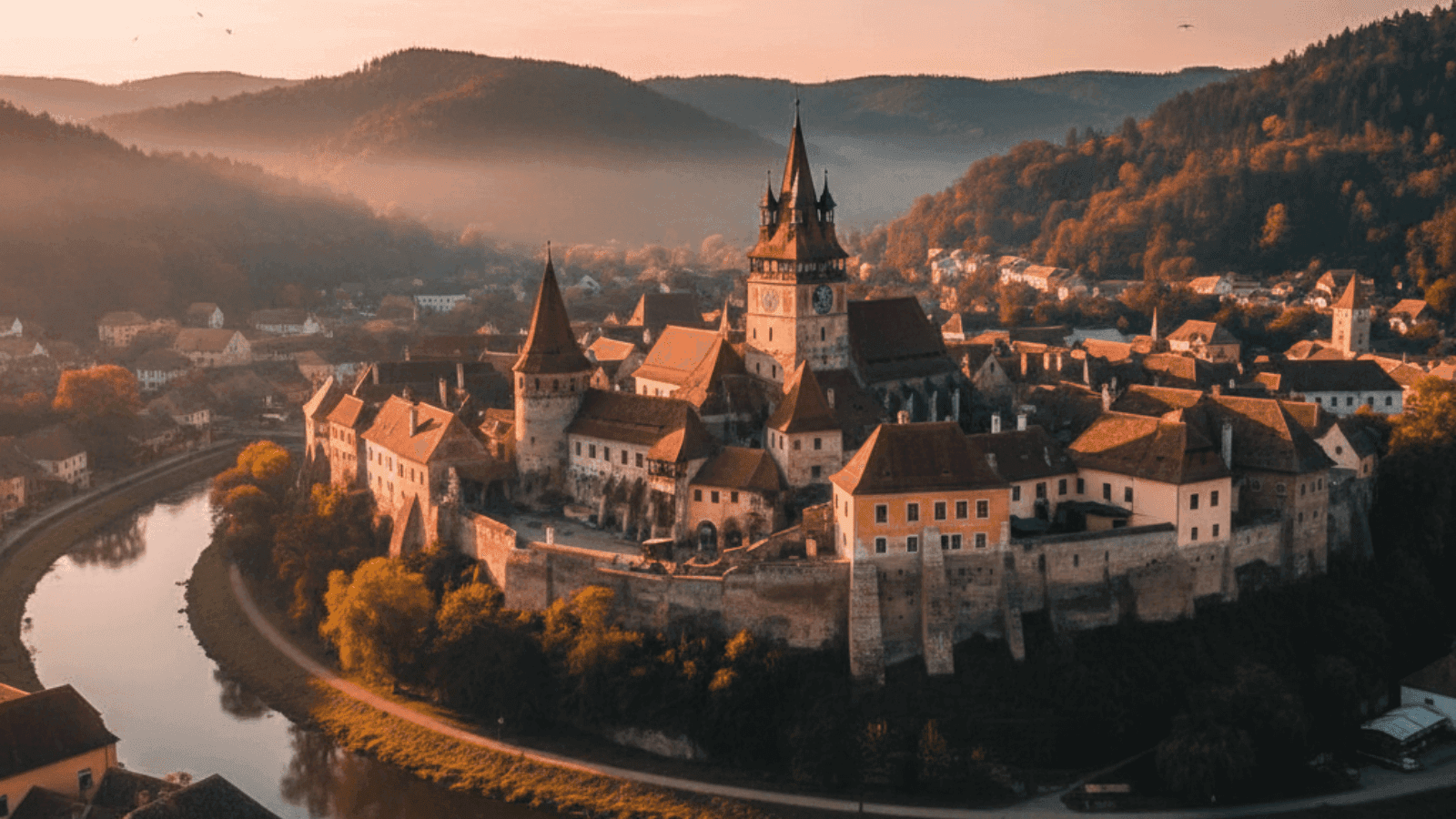
Transylvania, Where Medieval Europe Still Feels Alive Today!
Roofs here look like they listen. Towers rise like they are still keeping time for someone important. Walk a few steps on these stone streets and your footsteps fall into a rhythm that has been repeating for centuries.
Popular sights that still hold their medieval form
- Sighișoara: One of the last inhabited medieval citadels in Europe, with homes painted in muted pastels and a clock tower that has marked time since the 14th century
- Bran Castle: Built to guard a mountain pass, its narrow staircases and defensive towers show practical medieval engineering
- Brașov: A former Saxon trading hub surrounded by forested hills, known for its preserved town square and Gothic church
- Sibiu: Famous for rooftops with eye-shaped dormers that once served as ventilation and lookout points
- Fortified churches scattered across villages, originally built as both places of worship and defense
The medieval towns
Sighișoara feels untouched in ways that photographs rarely capture properly. Laundry still hangs between buildings inside the citadel walls. Locals walk uphill carrying groceries through gates built to stop invading armies.
The Clock Tower remains the central reference point. It once served as the main gate, city hall, and treasury. From the top, red tile roofs stretch outward in tight formation, a layout designed for protection and visibility rather than aesthetics.
Sibiu has a different mood. Wider squares reflect its history as a major trading center. Merchants once stored goods beneath their homes, and many of those vaulted basements still exist. The rooftops appear to watch over the streets, their narrow openings originally designed to release heat and smoke.

Why Transylvania still feels medieval
The towns were built by Saxon settlers invited by Hungarian kings during the 12th and 13th centuries. Their job was to develop trade routes and defend the frontier. They constructed fortified towns with thick walls, narrow entrances, and centralized squares.
Modern development largely bypassed these cores. Instead of demolishing and rebuilding, residents adapted the interiors while leaving the exterior intact. Wooden beams, uneven staircases, and stone foundations remain part of daily life.
Geography helped. Mountain barriers limited expansion and protected the region from rapid industrial change. Even railways arrived later here than in western Europe.
Best time to visit for atmosphere and movement
May through September offers the most access. Streets stay active, and mountain roads remain open.
June and July bring long daylight hours, which changes how the towns feel. The stone absorbs warmth, and evenings stretch naturally into late walks.
October introduces cooler air and fewer visitors. Fog appears more frequently around hilltop towns, especially in the mornings.
Winter transforms the region entirely. Snow covers rooftops and softens the hard geometry of defensive structures. Smaller towns become quieter but remain accessible.
How to reach Transylvania
- Fly into Bucharest, Romania’s capital, then travel 3–4 hours by train or car into the region
- Direct flights also connect major European cities to Cluj-Napoca, the largest city within Transylvania
- Trains connect Sibiu, Brașov, and Sighișoara regularly, and routes pass through mountain landscapes
- Driving allows access to smaller fortified villages that trains do not reach
How many days to plan
Three days allows enough time to visit one or two major towns and Bran Castle. Five days makes room for slower exploration. Travelers can move between Sibiu, Brașov, and Sighișoara without rushing. Seven days allows deeper access to villages, fortified churches, and lesser-visited areas where the medieval layout remains fully intact. Distances appear short on maps but take longer due to terrain.
Things to keep in mind while exploring
Streets inside medieval towns are often uneven. Comfortable footwear matters. Many historic buildings have narrow staircases without railings. English is widely spoken in major towns, though smaller villages rely more on Romanian.
Cash remains useful in rural areas. Morning and late evening are the quietest times to walk through citadel streets.
What to pack for a comfortable trip
- Comfortable walking shoes for stone streets and hills
- Light jacket even in summer, especially near mountains
- Camera with good low-light capability for early mornings and evenings
- Daypack for carrying essentials between towns
- Travel adapter compatible with European outlets.
If you want to wake up inside these medieval streets instead of just passing through, Neomaxer curates stays that place you right where the old towns breathe.









