
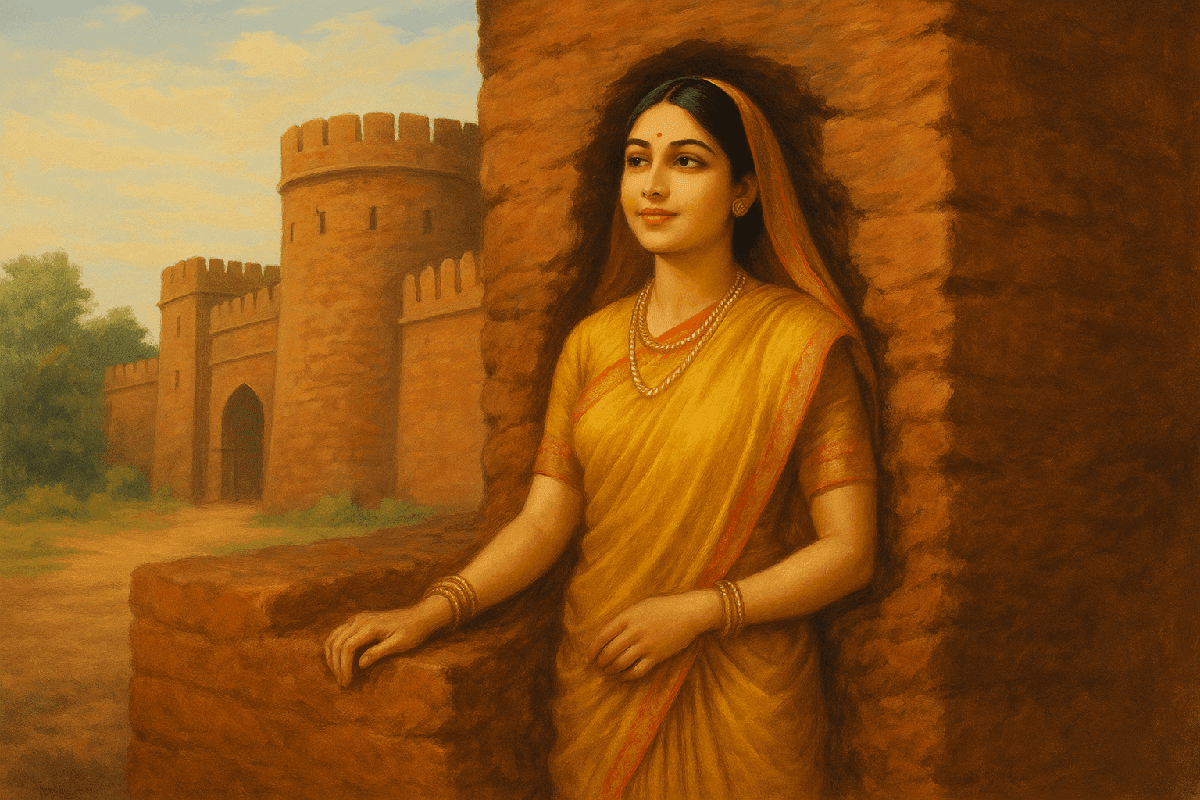
A vision was being fashioned out of red soil in the center of southern India in the 16th century, long before Bangalore developed into the huge IT hub it is today. Bengaluru was founded by the Vijayanagara Empire leader Kempe Gowda I, who had an idealized vision of a strong, prosperous, and trading metropolis. But something resisted as the land was painted with the initial lines of his vision. He commissioned a mud fort, but its southern wall, no matter how well-designed, would not stand. It collapsed repeatedly. Days or perhaps weeks passed until the foundations collapsed. It appeared that the earth was turning away from the metropolis.
What transpired is whispered in alleys and conveyed in temple rites, rather than recorded in official documents or stone inscriptions. The plot revolves around Lakshmamma, the daughter-in-law of Kempe Gowda, whose selfless and silent sacrifice made history.
The Birth of a City — and a Fort That Wouldn’t Hold
The foundation of Bangalore was a mud fort, which served as the focal point for the early city's development. Constructed in 1537 CE, this fort featured eight turrets, enormous stone and mud walls, and vigilant entrances that managed access. Rich in black cotton soil, near rivers, and at an elevation that was favorable for trade, the site was strategically important.
Although the majority of the fort's perimeter developed effectively, the southern wall continued to be problematic. Even after several attempts at reconstruction, it kept giving way. Soft soil was the engineer's fault. Priests murmured of spirits that were restless. Kempe Gowda's ideal was in danger of becoming a cautionary tale rather than a legacy as time was running out and finances were running low.
An incident that transpired during this time of despair has turned into one of Bengaluru's most eerie, although little-known, tales.
The Silent Martyr: Lakshmamma’s Secret
Lakshmamma, the wife of Kempe Gowda's eldest son, is said to have been silently seeing her father-in-law's suffering. Aware of the legend that sometimes demanded a human sacrifice to appease the spirits of the land, and realizing that even the king's might was insufficient to prevent the collapse, she made a disastrous decision.
She entered the foundations of the southern wall and let herself be buried in the mud of the fort without any fanfare, ceremony, or show. Not in a jail cell. In no way as a penalty. However, as a selfless sacrifice. A seal of man, fusing soul and soil, life and architecture.
That day was the last time the wall fell.
A Temple That Remembers What History Forgot
Lakshmamma is rarely mentioned in texts about history. There are no royal scrolls that mention her name. Big monuments are absent. In Koramangala, one of the busiest areas of modern Bengaluru, there is a little temple that is frequently disregarded. It is said to honor the woman whose blood kept the fort standing, according to the locals.
Unassumingly called the Lakshmamma Temple, it lacks opulence. It doesn't attract as many people as ISKCON or the Bull Temple. The few visitors, however, frequently arrive with a great deal of respect, burning lamps and silently praying for strength as well as blessings. The type of power that creates cities out of sacrifice.
The Cultural Context: Blood, Soil, and Spirit
Human sacrifice, or narabali, has a long history in South Asian folklore. A willing sacrificer's soul was thought to be able to appease elemental powers, which is terrible in today's terms. Invoking spirits with offerings, ceremonies, and in extreme situations, life itself, was common among builders, particularly in the construction industry where foundations had to last for generations.
The voluntary aspect of Lakshmamma's story is what sets it apart. She wasn't selected. She decided. And stability, not violence or conquest, was what she gave up. Architectural integrity is traded for a woman's life, not honor or retaliation. For her family. For an unborn city's future.
Traces of the Fort in Modern Bangalore
Due to Bengaluru's growth, the mud fort Kempe Gowda constructed has almost disappeared. However, if you know where to search, remains can still be found. Broken pieces of the Old Fort wall, partially engulfed by new structure and aged, are still visible in places like KR Market. Several of the city's old watchtowers, like as those at Lalbagh and Kempegowda Tower next to Mekhri Circle, serve as markers.
These relics do more than simply indicate the location of an ancient city; they retell its rich history of vision, hardship, and human passion. They serve to remind onlookers that beneath the concrete and glass of modern-day Bengaluru, there is a softer, older base made of myth, memory, and mud.
Why Her Story Still Matters
Lakshmamma's narrative serves as a reminder that some cities are created of feeling in an era when they are typically thought of as the result of investment and regulation. Personal loss in addition to work and ambition. She may never be mentioned in textbooks or travel guides, but her spirit endures in every stable road and unwavering building.
Death is not the only theme in her story. The intimate cost of creation is at issue, as civilizations are not built solely on blueprints. They arise from sacrifice, which is always necessary but might be silent or invisible at times.
A City’s Unsung Foundation
Despite being a city of startups, satellites, and speed, Bangalore has slower, more profound, and more revered roots. Take a moment to stop the next time you approach the ruins of Kempe Gowda's fort or cross the flyovers at Koramangala. The story you now carry is hidden beneath the walls, even if they may not speak.
Not in the context of war. not of victory. However, of a lady who turned into a wall—so that a city may rise.









