
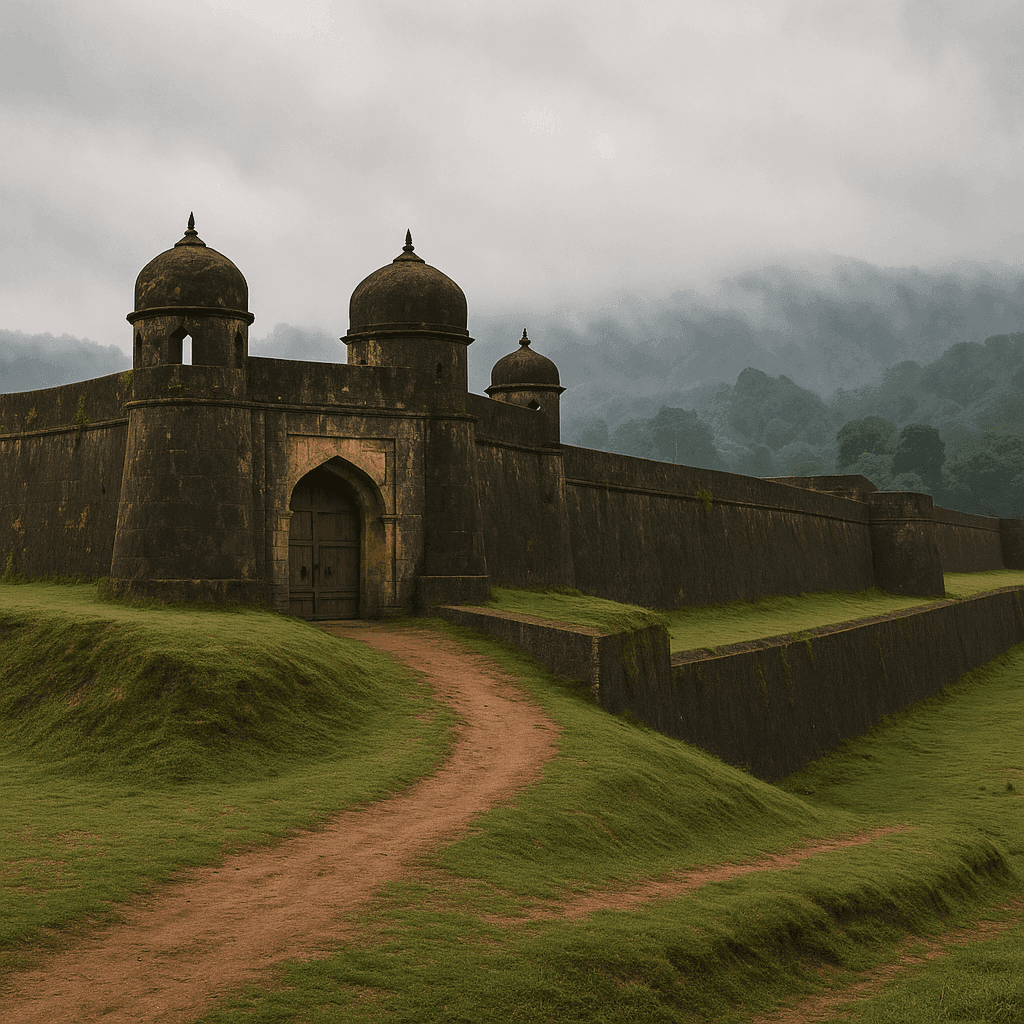
A fortress in the middle of the mist-covered hills of Coorg is home to many people's memories and is not exclusive to any one period. Throughout the years, Madikeri Fort, a now-fading but significant structure, has experienced name changes, religious conversions, and even political upheavals. The Haleri dynasty's royal hands, the Tipu Sultan's military might, and, eventually, the iron rule of the British Empire have all held sway over this stone guard over the years.
However, the ownership of the fort was not the only change. The entire identity of the Hindu kingdom was altered when its stones spoke the word Jaffarabad, which reflected Islamic imperial aspirations engraved into the mountains. Aspects of this remodeling and rebranding included architecture. With the help of philosophy, symbolism, and conquest, it was constructed one granite piece at a time.
As a result, Madikeri Fort, the capital of Coorg, became a location of varying power.
Origins in Mud: The Haleri Dynasty’s First Citadel
Madikeri Fort's history began in the 17th century when Mudduraja, a ruler of the Haleri family, built it out of mud in 1681. Madikeri was known as Muddu Raja Keri when it was first established. Additionally, Mudduraja established Madikeri as the capital of his burgeoning Kodagu empire.
His fort had a powerful function despite its simple design. Built mostly of wood and mud, it served as the royal family's home as well as a military installation. Its limits included a palace, barracks, administrative buildings, and modest shrines. With a broad perspective of the undulating Coorg hills and the significant trade routes that wound through them, it was in a prime location.
This early version of the fort was deeply rooted in the Kodavas' native architectural style and reflected the ethos of the area it was meant to protect.
A New Name, A New Stone: Tipu Sultan and Jaffarabad
When Tipu Sultan, the Tiger of Mysore, began focusing on Coorg in the late 1700s, everything changed. Tipu's expansionist goals and military strategies were intended to unite South India under his control by assaulting Kodagu and taking the fort.
Tipu Sultan destroyed the mud construction and rebuilt it in granite, adding Indo-Islamic features like domed bastions, arched entrances, and stone ramparts, in honor of its significance. A new identity, Jaffarabad, was created along with this shift, maybe in remembrance of a devoted lord in Tipu's court or even a religious figure.
This renaming was intentional and meaningful. As part of a broader attempt to establish Mysorean authority and eradicate local memory, Tipu attempted to eradicate the Haleri tradition and impose his own. Madikeri was a part of a broader story of the Islamic Empire for a short but significant time.
The Haleri Reclamation and Coorg’s Resistance
Coorg, however, has consistently upheld its independence. After Tipu was killed during the Fourth Anglo-Mysore War in 1799, the Haleri kings came back to retake their land. Madikeri was once again the Kodava stronghold following a bloody conflict headed by one of the most well-known dynasties, Dodda Vira Rajendra.
The name Jaffarabad soon vanished, and Madikeri Fort took its place. The fort's soul returned to the natives, despite Tipu's architectural contributions remaining in stone. Shrine of Hindu gods and statues of Haleri monarchs were restored. The fort began to represent Coorg's tenacious individuality once more.
British Conquest: A Fort with a View to Empire
Coorg was reached by British colonial advance by the middle of the 19th century. After a series of political ploys and the Haleri's eventual downfall, the British seized control of the area and merged it into the Madras Presidency.
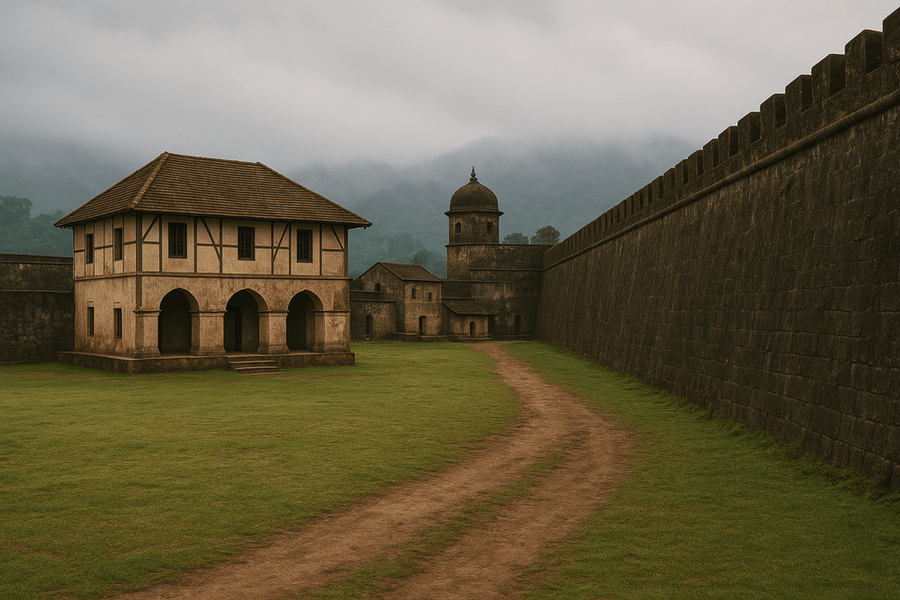
Madikeri Fort was converted into a British administrative and military base. The British Commissioner's office was in the Tudor-styled renovated royal residence inside the fort. The remains of a church called St. Mark's and a clock tower that were constructed inside the fort walls can still be seen today.
The British changed the fort's purpose but did not rename it like they did Tipu. It evolved from a palace or cultural stronghold to a representation of colonial rule, empire, and power.
The Architecture That Tells All
Each ruler's fingerprints are still visible on Madikeri Fort today. Its outer shell is formed by Tipu's granite ramparts. In the center lies the stone palace, which the British had significantly altered. The cathedral, which was once filled with hymns, is now home to the Madikeri Museum, which displays artifacts from Coorg's colonial and royal past.
Weapons, pictures of Tipu Sultan, paintings of the Haleri rulers, and even British souvenirs may all be found in the museum; each item adds a chapter to the fort's changing history.
Even though the fort walls are no longer used for fighting, they nevertheless stand tall and hum names like stone echoes: Madikeri, Jaffarabad, and Muddu Raja Keri.
Why It Still Matters
Madikeri Fort is a representation of individuality, defiance, and rebirth rather than merely a piece of architectural history. In India, very few monuments have had so many titles and functions while still maintaining their original location.
History isn't always linear, as it serves as a reminder. It can occasionally bend, loop, delete, and reappear. Names also carry weight in those cycles, not only as labels but also as assertions of authority and membership.
Every civilization that has left its mark and every king who has traversed these grounds can be felt quietly when one stands inside the fort now. Every name it carried was a dream. Every wall it included represented a distinct truth.
More than a historical building, Madikeri Fort is a stone-rewritten map of memory. Its fluctuating titles reflect the ebb and flow of identity, faith, and power in Coorg's history. This fort has changed without giving up, from its modest mud origins to its reinforced granite splendor, from Jaffarabad's Islamic symbolism to its colonial era.
And the tales of the people, monarchs, and emperors who have claimed it—only to have history reclaim it—will endure if its walls do.









