
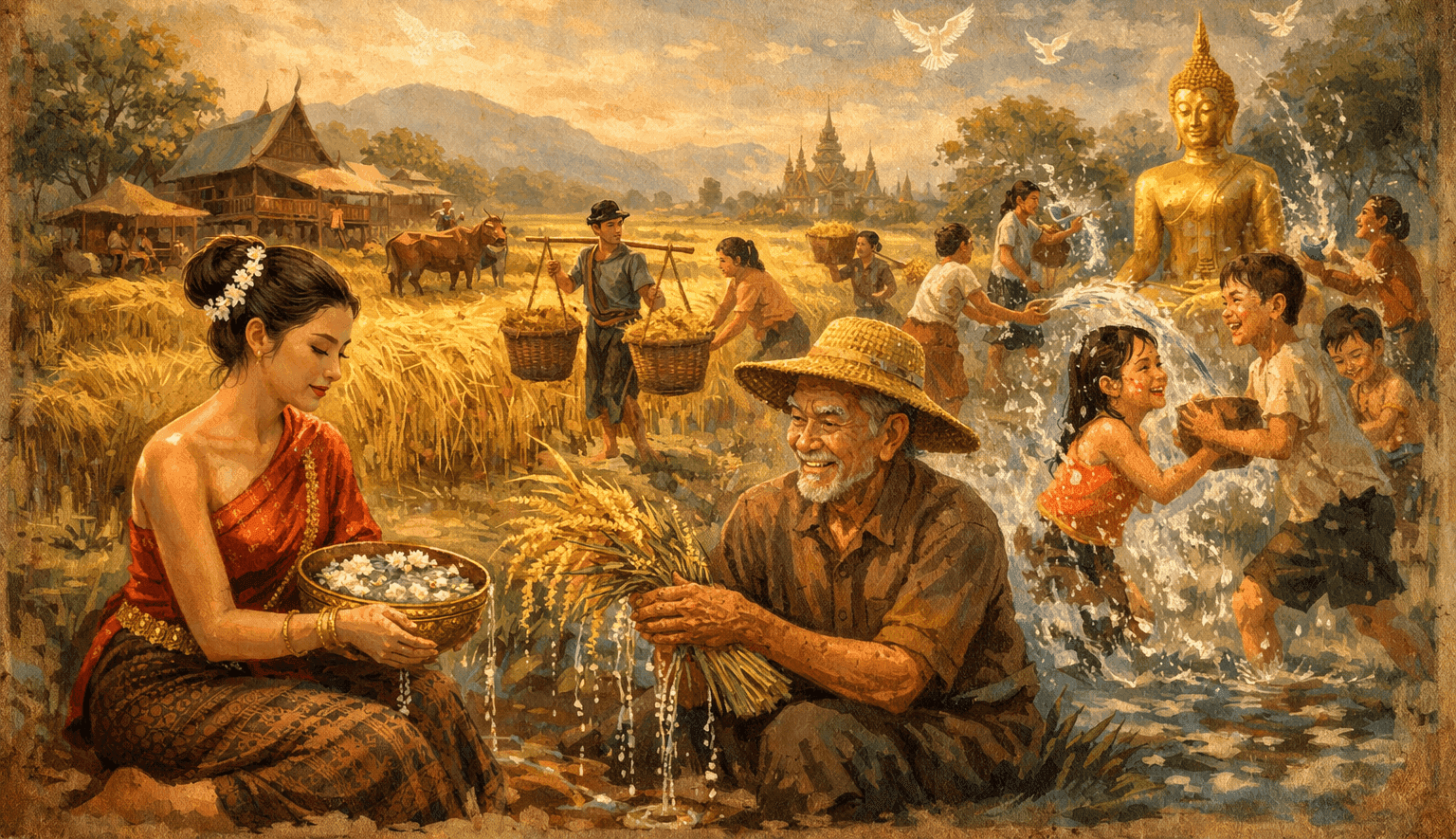
Songkran began as a quiet marker of seasonal change, long before crowds turned it into a water battlefield. Farmers once treated the shift with the same seriousness they used for reading soil moisture or watching the first wind of the new year. In some villages, elders still say that if you want to understand the older meaning, you must stand at dawn and listen for birdsong instead of speakers. The modern noise, from Siam Songkran to S2O Songkran Music Festival, belongs to another layer of celebration, not the root.
The Signs That Marked the Old New Year
In places where harvest cycles guided life, the first sign of Songkran was not water but air. Slightly warmer mornings. A change in the smell of fields. A river flowing just a little faster. Villagers knew when Songkran was without checking dates. The shift came from the ground upward.
Buddhist monks describe the original ritual as an act of cleansing, not spectacle. Water was poured slowly, respectfully, over statues and elders. It was a way to wash away the dust of one agricultural year and welcome the next. Songkran 2026 still carries this echo in small towns where tourists rarely stop.
Songkran Thailand 2026 will bring colour and noise to cities, but in northern rural belts, silence remains the first ritual. Families gather before sunrise. Hands are washed in scented water. Offerings are made to household spirits. These gestures are older than any festival stage or parade.

Where the Old Songkran Still Lives
To see the quieter version, you need to step away from Bangkok’s heat and the crowds preparing for Siam Songkran 2026. Chiang Mai’s narrow alleys hold the oldest patterns. Water bowls outside wooden houses are filled before daylight. Children carry petals instead of water guns. At temples, monks move slowly between groups, blessing each family with drops of cool water.
In Mae Hong Son, the mountains deepen the silence. The first light hits bamboo rooftops, and the entire valley feels paused. Locals say that Songkran 2026 dates will matter less here because the season itself decides the timing. They judge the moment by the glow of the morning fog.
Even in the Isan region, where the land is cracked and dry before the rains arrive, the celebration stays humble. Water is scarce, so every drop is measured. People sprinkle rather than splash. Their Songkran is a memory of rice fields waiting for the monsoon, not a display of endless buckets.
The Shift From Ritual to Celebration
Urban Thailand built a different identity around the festival. Siam Songkran Music Festival and other large events turned it into a cultural spectacle. Thousands gather. Speakers tower above the streets. DJs mark the beat instead of monks marking blessings. Songkran 2026 will likely add more light, more sound, and more crowds.
But in villages, elders still study wind movement the way their ancestors once studied harvest patterns. They speak about Songkran as if it were a living presence. If the wind arrives early, the year will be generous. If the mornings stay cold too long, they say the growing season will be delayed. This knowledge is not written, only observed.
While major cities embrace the S2O Songkran Music Festival, the countryside maintains its old pace. Children learn to prepare water with flowers and stems. Adults remind them that this is not about throwing but offering. A cup of water is carried like a message.
Following the River Instead of the Crowd
If you want to escape the noise of Songkran Thailand 2026, look for river towns where rituals stay steady. In Nan, families walk to the riverbank before sunrise. They dip their palms into cold water and lift them toward the sky, greeting the year as their grandparents did. No DJs. No announcements. Only the river’s slow voice.
Near Lampang, temples surrounded by teak forests hold ceremonies that last only minutes but feel heavier than any parade. Young people pour water on their elders' hands, wait for a blessing, and leave quietly. The festival ends the same way it begins, without spectacle.
The older meaning survives in pockets like these. Where harvest memories still shape the calendar. Where ritual replaces noise. And where Songkran feels less like an event and more like a signal carried by wind, water, and the first soft heat of the changing season









