
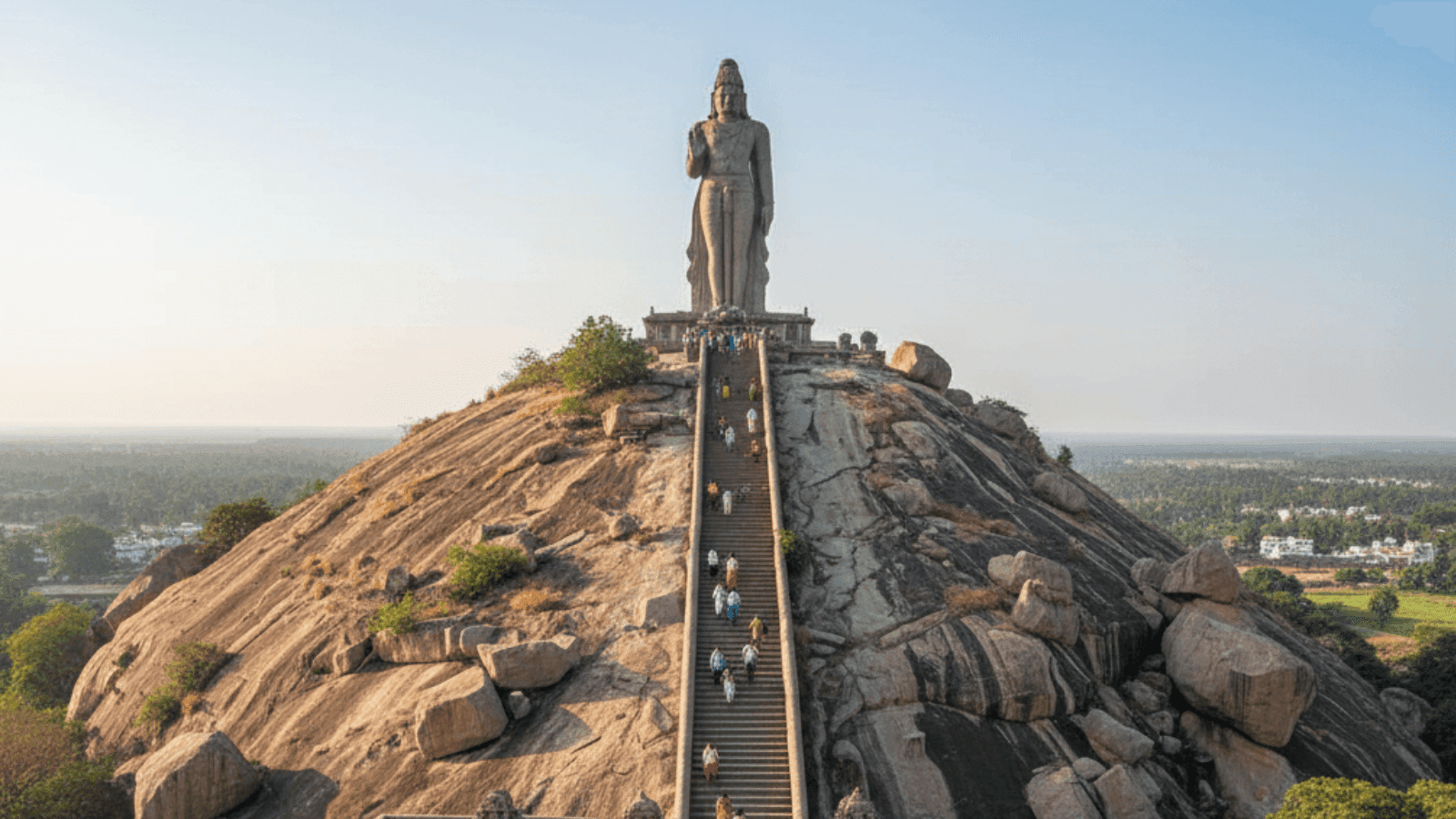
Shravanabelagola: The Hill of a Thousand Steps That Leads to 1 Silent Statue
The climb starts before you’ve decided if you’re ready for it. Stone steps rise fast, conversations thin out, and the hill offers no hints about what waits above. By the time you reach the top, silence feels earned, not given.
Where this place sits and why people still come here
Shravanabelagola is in Karnataka’s Hassan district, roughly halfway between Bengaluru and Mysuru. Two granite hills rise from a flat basin, with a small town pressed in between. One hill holds the statue. The other holds memory.
For Jains, this is one of the most important pilgrimage centres in South India. For travellers, it is a place where scale, effort, and silence meet without explanation. Nothing here is staged for visitors. The town functions around worship, not tourism.
When to plan your visit if you want the climb to matter
The hill heats up quickly. By late morning, the stone steps trap sunlight and reflect it back at your legs. Locals begin their ascent early, often before sunrise.
October to February is the easiest window physically. Monsoon months make the steps slippery, especially on the descent. During Mahamastakabhisheka years, which occur once every twelve years, accommodation fills up months in advance and movement on the hill is regulated tightly. On ordinary days, crowds thin out by afternoon. Silence increases as people descend.

What the climb actually feels like
There are over 600 stone-cut steps leading up Vindhyagiri Hill. The rise is steep, and the steps are shallow, worn smooth by centuries of bare feet. Iron railings appear only where the rock allows them. Resting points are unmarked. People stop where their bodies ask them to. The climb is not symbolic, but it becomes personal very quickly.
You will not see the statue until the end
There is no gradual reveal. No preview. No outline against the sky. The hill keeps the statue hidden until the final stretch, where the space opens suddenly into a broad stone courtyard. The shift in scale feels abrupt. Conversations tend to stop there.
Know the statue before standing in front of it
Who Bahubali is
The statue represents Bahubali, also known as Gommateshwara, son of Adinatha, the first Jain Tirthankara. After defeating his brother Bharata in a contest for kingship, Bahubali renounced power and stood in meditation until he attained kevala jnana, or absolute knowledge. The posture shown is kayotsarga, complete abandonment of the physical body.
Why the statue looks the way it does
The 58-foot figure was carved from a single block of granite in 981 CE under the patronage of Chavundaraya, a minister of the Ganga dynasty. It is not assembled, reinforced, or decorated. Creepers wind up the legs. Ant hills rise at the feet. The face carries no expression. The nudity is not symbolic ornament but a statement of total renunciation. The stillness is intentional, not aesthetic.
What happens here once every twelve years
Mahamastakabhisheka is the largest ritual performed at Shravanabelagola. Priests anoint the statue with water, milk, turmeric, saffron, sandalwood paste, and flowers poured from scaffolds built specifically for the ceremony.
The ritual uses 1,008 vessels and draws devotees from across India and abroad. Despite the scale, movement is controlled and quiet. Volunteers manage queues. Silence is enforced without signage. The last ceremony took place in 2018. The next is expected in 2030.
The second hill most visitors underestimate
Why Chandragiri matters
Opposite Vindhyagiri stands Chandragiri Hill, lower but older in historical weight. It houses multiple Jain basadis built between the 9th and 11th centuries, along with memorial stones and monk dwellings. This hill is associated with Chandragupta Maurya, who is believed to have renounced his empire and spent his final days here under the guidance of the Jain monk Bhadrabahu.
What you’ll notice if you slow down
The basadis are quiet, cool, and sparsely ornamented. Inscriptions are carved directly into exposed stone surfaces, not curated or protected behind barriers.
More than 800 inscriptions across both hills date from the 6th to the 18th centuries, recording grants, deaths, renunciation vows, and shifts in power. They are easy to miss if you move quickly.
How to reach Shravanabelagola without overplanning it
The town is about 145 km from Bengaluru by road. Buses and taxis run regularly from Hassan and Mysuru.
Shravanabelagola has its own railway station, connected to major cities in Karnataka. Mysuru Airport is the closest air option, though most visitors arrive by road. Arriving early matters more than arriving comfortably.
Where people usually stay
Accommodation options are modest. Pilgrims often stay in dharamshalas and guesthouses run by Jain trusts. Hassan town offers more hotel choices if you prefer basic comfort over proximity. During festival periods, availability tightens quickly, and last-minute planning usually fails.
What behaviour is expected without being said
Footwear is removed at the base. Voices lower naturally as people climb. Photography is allowed, but people take fewer pictures than expected.
Monks move through crowds unnoticed. Vendors sell small stone replicas of Bahubali in measured sizes. Meals are simple, vegetarian, and served without explanation. The discipline here is learned by watching others, not by reading instructions.
What stays with people after they leave
The view from the top shows fields, tanks, tiled roofs, and roads that look ordinary from a distance. Most people spend more time standing still near the statue than looking outward, letting their breathing return to normal, waiting for nothing in particular, before turning back to the steps.
If climbing ancient steps and standing before something truly still is your kind of travel, Neomaxer helps you stay close to places that feel real.









