
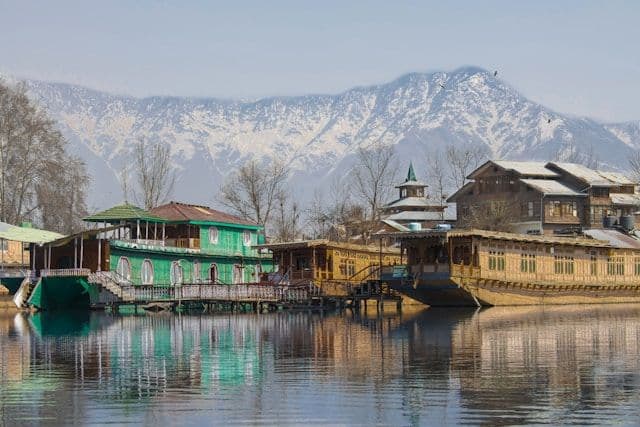
Ink spreads slightly on paper as a shikara rocks under your elbow, and Srinagar feels close enough to fold into the letter itself. The lake carries sound, reflections, and patience, and Srinagar turns a simple act of writing into something that drifts before it arrives. The boatman steadies the shikara with a practiced foot, barely touching the water, while your notebook rests on a wooden plank smelling of varnish and damp air. Every sentence slows down because the lake demands it, words arriving at the same pace as ripples that widen and disappear.
Writing while floating
Dal Lake once moved more than tourists. Letters, goods, news, and gossip crossed this water long before roads mattered, and writing here feels less romantic and more honest. You are not pretending to slow down; the lake decides for you.
Oars dip quietly, water birds call from the reeds, and distant prayer echoes across the surface. Writing becomes listening, and silence turns into punctuation. You pause not because you are unsure, but because the water asks you to wait.
The feel of time on water
Minutes stretch without resistance. The shikara does not hurry even when another boat passes, sending small waves that gently rearrange your balance. Ink dries slower here, as if the page itself is adjusting.
You notice how thoughts arrive differently. Instead of chasing them, you let them float closer, choosing only what feels steady enough to stay.
Weather decides the pace
People check the Srinagar weather before planning a walk, but on the lake, you check the sky instead. Clouds drift low, sometimes brushing the hills, and Srinagar's weather today can change mid-paragraph as sunlight turns to shade without warning. Moisture curls the edges of paper if you linger too long, teaching you to write with intention.
The Srinagar temperature keeps ink flowing but fingers cold in the morning. Gloves come off only long enough to finish a sentence, then slip back on while you read it once more.
Houseboats and living addresses
Houseboats line the lake like floating neighborhoods, each with a carefully painted name and a quiet sense of permanence. Curtains move, kettles whistle, and someone waves from a doorway without curiosity. These boats once worked as addresses, where letters paused before moving on.
Envelopes changed hands across narrow bridges and decks. Sealing yours feels deliberate even without wax, as if intention alone can hold it shut. The act of finishing matters as much as the words inside.
The weight of finishing
You reread the letter once, then again. There is no urge to perfect it. The lake has already decided when it is complete.
Closing the notebook feels like closing a door gently. Nothing rushes you toward the next step.
From water to land
Stepping off the shikara feels like waking up. The ground is steady but unfamiliar after hours of gentle movement. The post office looks ordinary, yet the path to it carries the lake with you, shoes still damp, thoughts still drifting.
The city hums louder away from the water. Shops and scooters stack noise on noise. Overhead, planes approach Srinagar airport, reminding you how quickly people pass through.
Speed versus waiting
Cars push along the Jammu-Srinagar highway. Messages arrive instantly on screens. Trains pull into the Srinagar railway station carrying stories more than letters now. Dropping the envelope into the slot feels heavier than expected.
You do not track it. There is no update or confirmation. Trust becomes part of the ritual. A letter insists on delay and chooses patience over urgency.
Roads the letter will never see
Travelers nearby discuss routes, mentioning the Srinagar to Gulmarg distance like a neat calculation, though the road itself curves and climbs through changing light. Others talk about the Srinagar to Pahalgam distance, recalling rivers, pine forests, and roadside stops that stretch the journey.
Your letter skips all of this. It chooses quieter paths that do not appear on maps. Distance here feels emotional rather than measured.
Returning to the lake
Walking back toward the water, city noise loosens its grip. The shikara waits without comment, tied loosely as if confident you will return. Afternoon light scatters silver across the lake, houseboats glowing softly as kitchens begin to work.
Tourists lift cameras. Locals move around them with ease. Life continues without posing. Your letter carries no image, only words shaped by this rhythm.
Writing without witnesses
Back on the water, you open the notebook again but do not write. The page stays blank, and that feels right. Some moments ask to be noticed, not recorded.
You watch another shikara glide past, the boatman humming quietly. The lake absorbs it without reaction.
The habit of slowing down
Long after the letter leaves your hands, the lake keeps teaching the same lesson. You walk slower without meaning to, pausing when a sound catches your attention or when light shifts across the water. Even errands feel less urgent, as if time has loosened its grip.
You notice small things more easily. A crack in the wooden edge of the shikara. Ripples bending reflections into unfamiliar shapes. The quiet confidence with which locals move across water that outsiders still treat as a spectacle. Slowing down stops feeling like a choice and starts feeling like a condition of being here.
What the lake gives back
The lake does not reward you with answers. It offers space instead. Thoughts settle without effort, and questions stop demanding resolution. You carry this calm with you, even when you step away.
Later, when you think about the letter, you remember less of what you wrote and more of how it felt to write it. The weight of the pen. The gentle sway beneath you. The sense that being present mattered more than being precise.
Evening and pause
As dusk settles, reflections double and then fade. Smoke curls from rooftops and boats alike. Writing stops, but thinking does not, and the lake holds both without judgment. Lights flicker on, stretching into long lines across the surface. Conversations soften. The water smooths itself.
Night sounds on the lake
Oars knock gently against wood. Somewhere, a radio plays low. A dog barks from shore, answered by another far away.
You feel the day closing without ceremony. The letter already feels distant, as if it belongs to someone else now.
Morning after
You wake early the next day, checking Srinagar weather today out of habit, though the sky answers first. Mist lifts slowly, revealing outlines that already feel familiar. The lake looks unchanged, as if it never noticed your presence.
Boats begin moving again. Life resets itself with quiet efficiency.
Letting it be enough
You consider writing again, but stop yourself. Repeating the act would change it. Watching shikaras carry guests away, you notice how the water closes behind them and becomes smooth again.
The letter is already gone, moving at land speed now, while your body still sways slightly. Srinagar stays behind as you move on, a place where you trusted water to carry your words and accepted that arrival would happen on its own time.









