
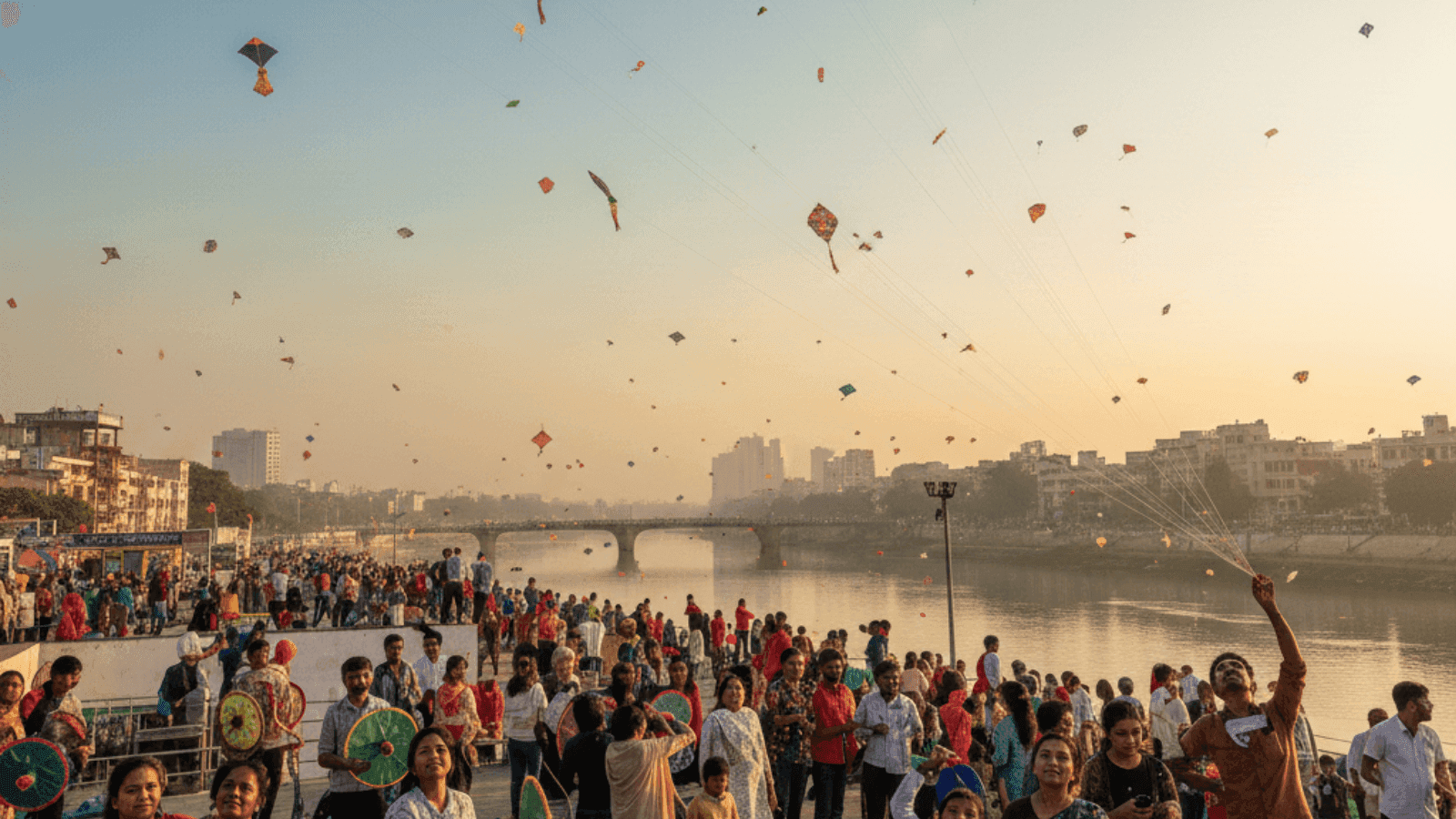
All Roads Lead to Sabarmati During Gujarat’s Kite Festival
By the second week of January, Ahmedabad wakes up looking at the sky before it looks at the road. Kites appear before breakfast, rooftops fill without invitation, and the city’s rhythm shifts quietly toward the sky. When Gujarat celebrates its kite festival, every road eventually leads to the Sabarmati.
Sabarmati Riverfront Becomes the Festival Hub
The Sabarmati Riverfront is not the only place where kites fly, but it is where everything converges. This is where international flyers unpack their crates, where scale becomes spectacle, and where the festival’s many local versions briefly meet.
During the International Kite Festival 2026, the riverfront hosts the main celebrations from January 12 to 14. Long before the first kite is released, crews line the promenade with installations, shaded seating, performance zones, and launch areas designed for massive builds that would never survive a crowded neighbourhood rooftop.
Uttarayan Is Older Than the Festival
Uttarayan predates banners, schedules, and international delegations. It marks the sun’s northward movement, the end of winter’s grip, and the start of longer days. In homes across Gujarat, this is when undhiyu simmers slowly, sesame laddoos appear in steel tins, and children learn to hold manja without slicing their fingers.
The International Kite Festival grew out of this domestic ritual rather than replacing it. On January 14, when Makar Sankranti arrives, Ahmedabad’s rooftops are louder than the riverfront. Music blares from phones, not stages. Victory shouts echo between buildings. The competitive edge sharpens, and the sky becomes crowded with intention.
The International Presence Changes the Scale

These are not patangs meant for combat. They are designed for endurance, visibility, and narrative. A single kite may take hours to assemble and several people to guide. Watching them rise is less about speed and more about patience, something local flyers instinctively recognise.
Traditional Indian kite makers share the same field. Tukals and hand-painted patangs sit beside contemporary materials, showing how craft adapts without losing its hand-drawn soul.
Dates, Cities, and How the Festival Spreads
From January 10 to January 14, 2026, events unfold across Gujarat, with Ahmedabad acting as the anchor rather than the only stage.
Festival Schedule Across Gujarat
- January 10: Rajkot, Surat, Dholavira
- January 11: Shivrajpur, Statue of Unity (Ektanagar), Vadnagar
- January 12–14: Ahmedabad (main celebrations at Sabarmati Riverfront)
- January 13: Vadodara
- January 14: Hanol and Palitana, alongside ongoing Ahmedabad events
This spread matters. In coastal towns, wind behaves differently. In heritage locations like Vadnagar and Dholavira, the contrast between ancient stone and moving colour creates a quieter visual drama. Ahmedabad absorbs it all, then amplifies it.
What Happens Alongside the Flying
Folk musicians perform garba and dayro sets that draw small circles of listeners rather than large crowds. Artisans sell paper kites, spools, and handmade strings dyed in improbable shades. Children gather around kite-making workshops, folding paper badly at first, then better, then proudly.
Food stalls do steady business throughout the day. Undhiyu appears early, laddoos later. Chikki vendors compete with sugarcane juice carts. The smell of fried snacks mixes with river air, creating a sensory layer visitors remember more clearly than photographs.
Timing, Access, and How People Actually Experience It
Entry to the Sabarmati Riverfront events is free. Most activity runs from around 10 am to 5 pm, with cultural performances extending into the evening. Locals arrive early, leave for lunch, and return again. Visitors tend to stay put, slowly realising that the best moments are unplanned: a kite breaking free, a sudden wind shift, a spontaneous cheer. On Sankranti itself, many skip the riverfront entirely. Rooftops become the real arena. The soundscape changes from curated music to shouted challenges. Strangers negotiate shared terraces. Someone’s radio plays old film songs on repeat. If you want to experience Uttarayan without worrying about logistics, crowded stays, or last-minute chaos, Neomaxer curates stays that keep you close to the celebration while giving you space to relax.









