
One Sun, Twelve Names: How India Celebrates Sankranti
The Sun does not change, but India’s relationship with it does, every few hundred kilometres. Somewhere between boiling rice and flying kites, the country quietly agrees to celebrate the Sun.
When the Sun Turns North
Makar Sankranti marks the moment the Sun enters Makara (Capricorn) and begins its northward movement, known as Uttarayana. Unlike most Indian festivals tied to the lunar calendar, this shift follows the solar cycle, which is why the date stays largely fixed around mid-January. For farming communities, this change has always mattered. Longer days mean warmer fields, resting soil, and the promise of new work.
Across centuries, this astronomical event became a social marker. Crops were stored, debts settled, and households paused long enough to acknowledge that survival, once again, had depended on light.
One Festival, Many Names
Punjab and Haryana - Lohri and the Language of Fire
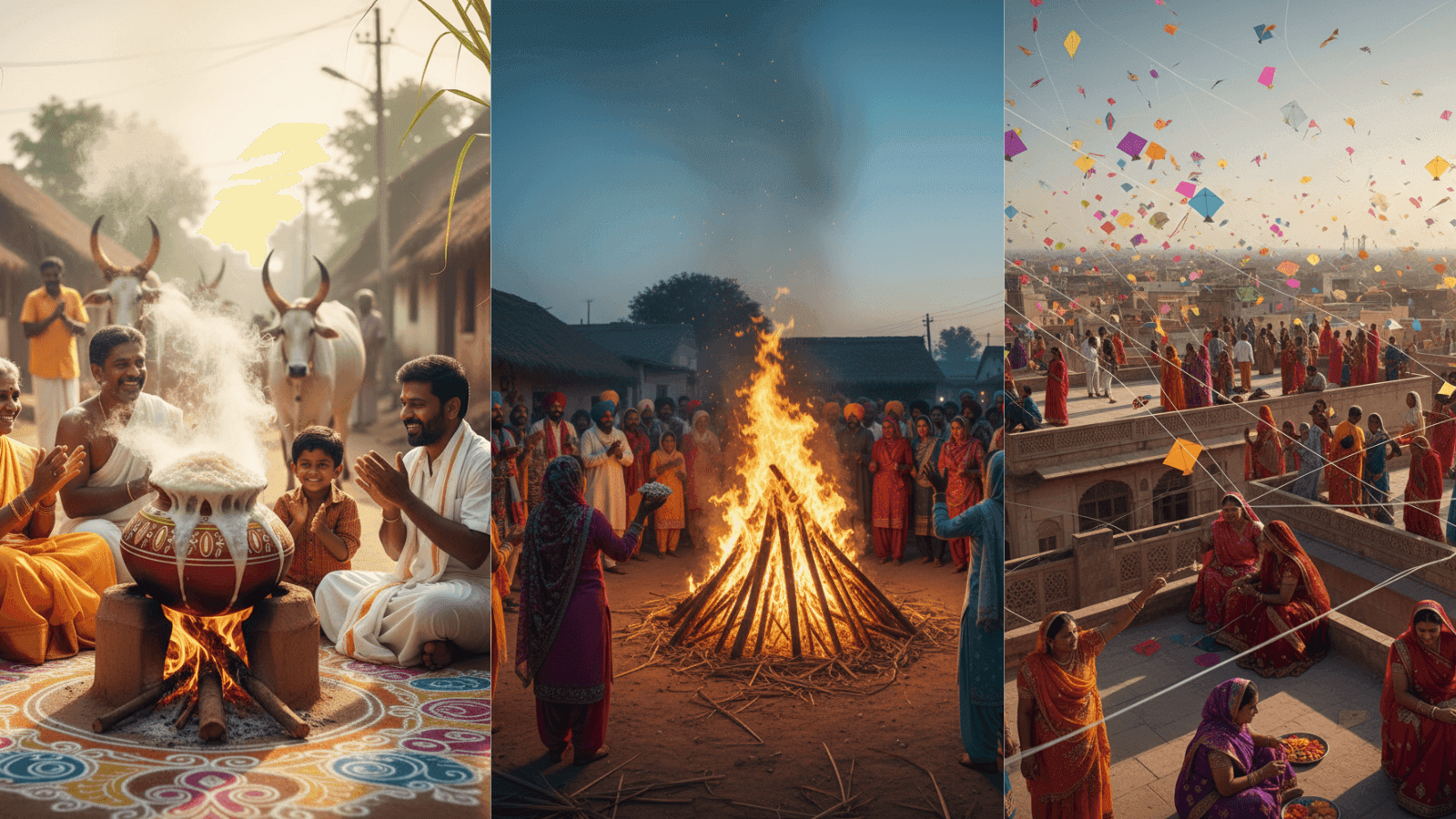
In Punjab and Haryana, the festival arrives as Lohri, welcomed with bonfires built from sugarcane husk and wood. Fire becomes the centre, not as spectacle but as witness. Songs are sung in loose circles, offerings are tossed into the flames, and winter is thanked for finally loosening its grip.
Gujarat and Rajasthan - Uttarayan in the Open Sky
In Gujarat and Rajasthan, Uttarayan lifts its head into the sky. Kite strings slice the air from morning to sunset, rooftops filling with neighbours who otherwise barely cross paths. Victory matters less than presence. Even lost kites are cheered, followed by shared snacks and shouted warnings about sharp strings.
Tamil Nadu - Pongal and the Visibility of Abundance
Tamil Nadu stretches the celebration into Pongal, four days that move from discarding the old to honouring cattle, harvest, and kinship. Rice boils over in open pots, not quietly on stoves, because abundance is meant to be seen. The act of cooking itself becomes prayer.

Assam - Magh Bihu and Temporary Joy
In Assam, Magh Bihu shifts the focus to community feasts. Temporary huts rise overnight, meals are cooked together, and then the structures are burned down. The celebration carries a quiet reminder that joy, like shelter, can be meaningful even when it is brief.
West Bengal - Poush Sankranti and Winter Sweets
West Bengal calls it Poush Sankranti, where winter sweets take precedence. Pithe, steamed or fried, are made at home, not bought. Skill matters. Time matters. The festival moves slowly, shaped by kitchens more than courtyards.
Uttar Pradesh and Bihar - Khichdi and Shared Simplicity
Uttar Pradesh and Bihar keep it simple with Khichdi, food that feeds many without display. Rivers take on ritual importance, not because they are scenic, but because they have always carried people through scarcity. Mornings begin early and quietly, long before the food is served.
Shared Rituals That Refuse to Disappear
Despite regional differences, certain practices repeat themselves with stubborn consistency. Sesame seeds and jaggery appear everywhere, shaped into laddoos, chikki, or brittle sweets. They warm the body, but they also last. These are foods designed to survive travel, sharing, and storage.
Holy dips happen at dawn, often without ceremony. Rivers are cold, crowds are quiet, and prayers are short. It is not about spectacle. It is about timing.
Charity becomes routine. Grain, clothes, cooked food, and money are given without announcements. In villages, this looks like a neighbour quietly leaving a sack at another doorstep.
Special Foods Prepared on Makar Sankranti
Til and Jaggery Sweets
Laddoos, chikki, gajak, and brittle made from sesame seeds and jaggery dominate Sankranti kitchens. These foods are warming, durable, and meant to be shared widely during winter.
Khichdi
Prepared with rice, lentils, vegetables, and ghee, khichdi represents simplicity and nourishment. It appears in many regions with slight variations, valued more for what it provides than how it looks.
Pongal
Made from freshly harvested rice, Pongal appears in both sweet and savoury forms. The act of cooking it outdoors and allowing it to boil over is as important as eating it.
Rice and Coconut Sweets
In eastern and southern India, rice flour and coconut come together in steamed or fried sweets. These dishes rely on seasonal produce and home preparation.
Undhiyu
A slow-cooked vegetable dish from Gujarat, Undhiyu uses winter vegetables available only briefly each year. Its preparation takes time, making it inseparable from the season itself.
Twelve Names, One Season
Across India, Sankranti answers to many names: Lohri, Pongal, Uttarayan, Magh Bihu, Poush Sankranti, Khichdi, Pedda Panduga. Each name reveals what mattered most to that region - fire, food, sky, cattle, or river. What remains constant is restraint. This is not a loud festival by design. Joy arrives through routine, repetition, and familiarity. The Sun rises the same way everywhere that morning, but what people choose to do with that light depends entirely on where they stand. If you want to experience Sankranti where it’s actually lived in villages, small towns, farms, and slow mornings, where you stay matters. Neomaxer curates stays that place you close to local traditions, seasonal food, and the kind of quiet celebrations









