
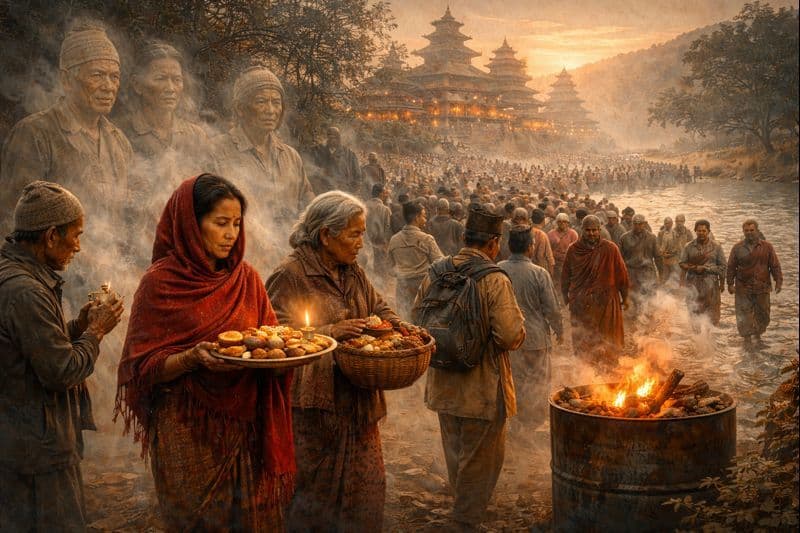
Maghe Sankranti arrives with a certainty that people in Nepal can feel before they check calendars. The cold settles differently. Smoke from morning kitchens rises straighter. Families know the day is close because every household starts preparing seeds, ghee, and the thick roots that only appear in markets at this time. Even before someone asks when Maghe Sankranti is, the signs are already present in the way elders talk and the way doorways are cleaned.
The Pull of the Ancestors
People say Maghe Sankranti is about warmth, but it is also about presence. Not the presence you see, the presence you sense. Old homes in the hills keep a separate corner ready for ancestral offerings. A small plate of sesame treats. A little ghee. A few grains of rice are placed with careful hands. No one calls for spirits. They simply assume the ancestors arrive when the first light touches the courtyard. The day is quiet, but not empty.
Pilgrims travel before dawn during Maghe Sankranti 2026, heading toward holy rivers where the year feels like it restarts. In the cold, conversations become whispers. People avoid stepping on certain stones near temple entrances. They say footsteps disturb those who return briefly from beyond the veil. This belief is not written in guidebooks. It is learned by watching grandparents pause before crossing thresholds.
Rivers, Roots, and Memory
The holy dip is not a dramatic act. It is slow, deliberate, almost cautious. In villages where Maghe Sankranti in Nepali culture runs deep, men and women enter the river as if the water itself might be listening. The current is low in winter, so footsteps create soft ripples. Some say these ripples carry messages to ancestors who left long ago. Others say the river simply purifies intentions. No one argues. Sankranti days are not made for arguments.
Maghe Sankranti food tells its own story. Heavy with ghee, rich with sesame, sticky with molasses. Tarul, yams, sweet potatoes, and laddus that leave fingerprints of oil on banana leaves. These dishes are not eaten for indulgence. They were once foods of survival during harsh winters. People still say the warmth stays in the bones longer if eaten on this day. Children may not know the meaning behind the flavours, but they never refuse a second serving.
The Geography of Devotion
Maghe Sankranti is celebrated in which state becomes a confusing question because borders do not decide devotion. It is felt from the plains of Madhesh to the cold heights of the Himalayas. In Tharu villages, the festival blends with community gatherings where drums echo through the night. In Newar homes, sesame dominates every plate. In the middle hills, elders sit by the fire and talk about relatives who walked these valleys a century ago.
Each community moves through the day with its own rhythm. Some visit Shiva temples. Some stay home and light lamps near water pots. Some travel to the confluence of rivers where three currents meet. People do not explain why they choose one ritual over another. The choices are inherited, not negotiated.
When Maghe Sankranti 2026 arrives, the roads to major riverbanks thicken with footsteps. You can hear early morning chants before you see the crowds. Vendors set up fires in metal drums to warm their hands. Pilgrims pass them without stopping because the cold is part of the journey. Even the quiet moments feel watched, as if ancestors move between the living unnoticed.

A Festival of Seen and Unseen
The festival holds a strange balance. Life and death, warmth and cold, food and fasting. Children laugh while rolling sesame sweets. Elders sit still, eyes lowered, remembering faces no longer here. No one explains this contrast to visitors. It is simply understood that the day belongs to both worlds.
Maghe Sankranti food continues to ground the festival long after sunrise. Homes fill with the smell of clarified butter, roasted seeds, and warm roots. People return from riverbanks with wet hair and numb fingers. They gather by indoor fires, eating slowly, talking less. The conversation turns to who visited in dreams the night before, and who might return this year.
Stories travel gently across rooms. No raised voices. No insistence on belief. The festival creates a space where memory becomes almost physical. A cup of warm milk was set aside on a shelf. A lamp kept burning until midnight. These gestures are small, but they keep the past close.
Maghe Sankranti holds the kind of silence that carries weight. Even visitors feel it. They notice how people move with intention, how nothing is rushed, how every action seems linked to someone who once lived. The festival does not try to impress. It only tries to honour.
Maghe Sankranti moves toward its end without ceremony. Fires burn low. Plates empty. People step outside to look at the winter sky. No one says goodbye to the ancestors. They leave the way they came, without noise. The day settles into quiet again, and the presence slowly fades.









