
Why Maharashtra’s Sankranti Is Passed Hand to Hand and not Through Plates
Sankranti in Maharashtra doesn’t begin at the dining table. It starts at the doorway, with someone holding out a small piece of Tilgul and a sentence you’re expected to mean. Before you’ve settled in, sweetness has already changed hands.
The Festival Runs on Conversation
Makar Sankranti here is less about what sits on the plate and more about what moves between people. The act that defines the day is not eating but giving. Tilgul changes hands dozens of times, often without anyone sitting down to a meal. Neighbours drop by unannounced. Conversations start mid-sentence. Sweetness is offered before pleasantries.
The phrase “Tilgul ghya, god god bola” is not decorative. It is a verbal contract. Accept the sweet, and you agree to soften your words, even if only for this season. In many homes, the sentence is said slowly, deliberately, like it needs to be heard properly to work.
Why Tilgul Must Be Handed Over
Tilgul is dense, sticky, and intentionally small. It cannot be plated elegantly or eaten distractedly. It demands attention. Sesame and jaggery are winter foods, but more importantly, they are binding foods. Jaggery melts, sesame holds shape. Together, they mirror how people are expected to behave with one another during this time.
Passing Tilgul by hand removes distance. No serving spoon. No hierarchy of host and guest. Everyone becomes a participant, not an audience. Even children are taught to offer it correctly, palm forward, eyes up, words spoken clearly.
Sankranti Foods That Carry Warmth
Maharashtra’s Sankranti kitchen leans heavily on ingredients that hold heat and energy through winter. The dishes are sturdy, simple, and designed to be shared repeatedly across the day.
Tilgul Ladoo
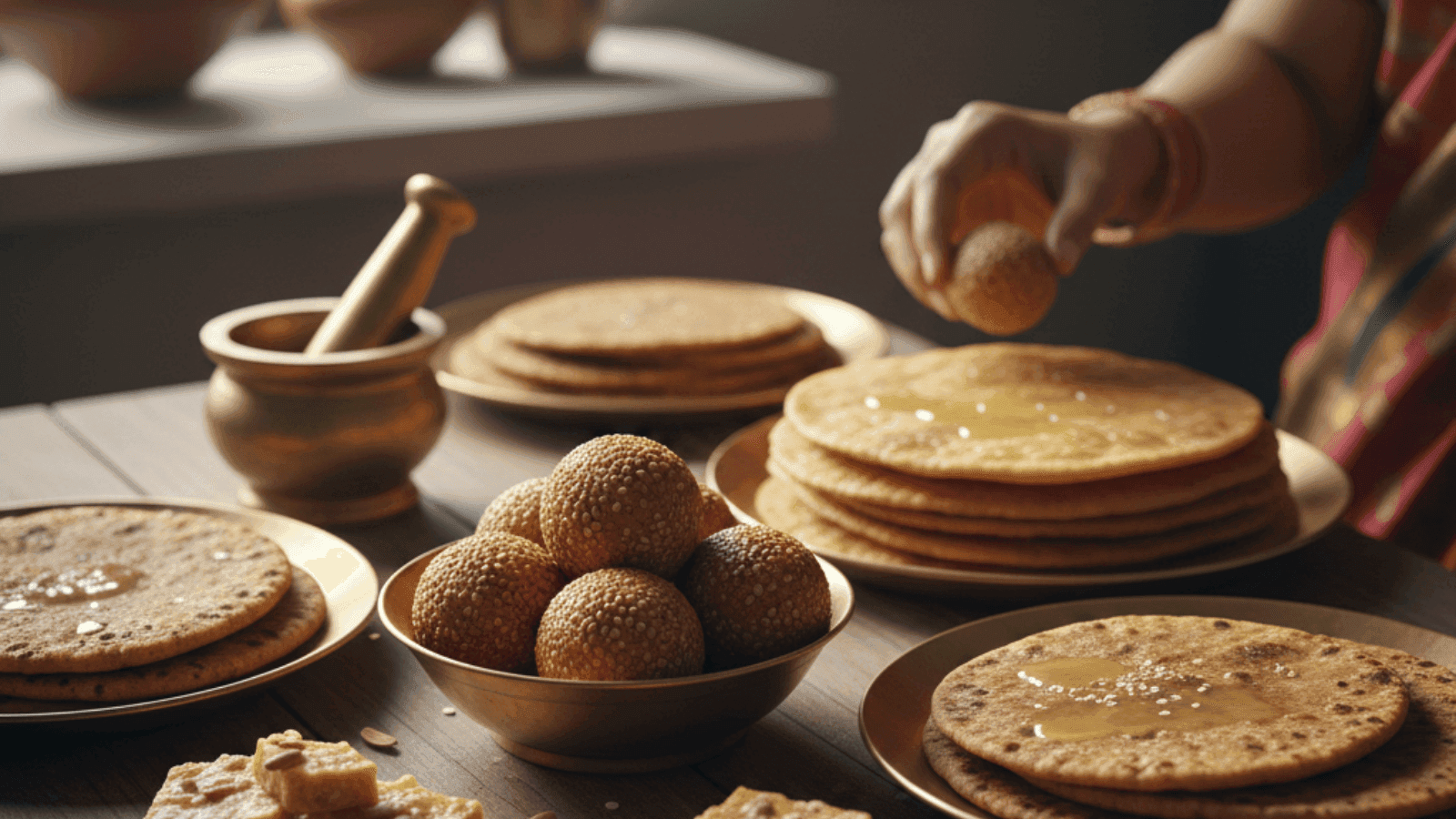
Roasted sesame seeds bound with jaggery, shaped firm enough to travel from house to house without breaking. These ladoos are exchanged more than they are eaten.
Puran Poli
A soft flatbread filled with jaggery and chana dal, usually brushed with ghee and served warm. It appears between visits, not as a formal meal.
Til Poli
A sesame-forward version of puran poli, heavier and more seasonal, made specifically for Sankranti.
Gulachi Chikki
Jaggery brittle mixed with sesame, peanuts, or coconut, broken into uneven pieces and shared casually rather than plated.
Haldi-Kumkum as a Moving Social Circle
Haldi-Kumkum gatherings look formal from the outside, but their structure is loose by design. Women move in and out of homes throughout the day. There is no fixed seating. No start or end time. Gifts are modest, sometimes symbolic, sometimes improvised.
What matters is the movement. Haldi and kumkum are touched, applied, returned. Hands meet constantly. Conversations overlap. Recipes, complaints, news, and silence all coexist in the same room.
Why These Gatherings Happen at Home
Hosting Haldi-Kumkum at home removes the neutrality of public space. It forces intimacy. Kitchens are visible. Courtyards are shared. Someone’s floor is always slightly uneven. This domestic setting reinforces equality. Everyone hosts. Everyone attends.
The gifts exchanged are rarely impressive. Bangles, coconut, small containers of sugar or Tilgul. Their value lies in repetition, not rarity.
Black Clothing and Practical Defiance

Food Exists, but It Is Not the Centerpiece
Puran Poli, Til Poli, Gulachi Chikki, and Tilgul Ladoo are prepared carefully, often over several days. But they are not showcased. Nobody waits for a formal meal to begin the festival. Eating happens in gaps, between visits, between conversations.
Tilgul ladoos are deliberately firm. They last. They travel. They survive pockets, handbags, bus rides. Their purpose is distribution, not indulgence.
Jaggery and sesame generate heat in the body, but they also carry instruction. Stay warm. Stay sweet. Stay together. These are not abstract ideas. They are repeated physically, dozens of times, through touch and taste.
Seasonal Practices That Naturally Avoid Waste
Using organic jaggery, reducing plastic packaging, and simplifying Haldi-Kumkum gifts are not framed as sustainability efforts. They are extensions of an older ethic. Waste disrupts circulation. Excess slows movement. Sankranti values what can move easily between hands.
Why the Sweet Is Never the Point
Tilgul is exchanged even when nobody is hungry. Even after meals. Even late at night. The sweetness is secondary to the action. What is being passed is acknowledgment. Recognition. Temporary forgiveness. A reminder that speech can be softened, if only someone initiates it.
The festival persists because it requires participation, not observation. Because it insists that people show up physically. Because sweetness here is not consumed, it is transferred. If you want to see how festivals like Sankranti are lived outside the usual tourist routes, staying close to local neighbourhoods makes all the difference. Neomaxer lists stays that keep you inside everyday life rather than on the edges of it.









