
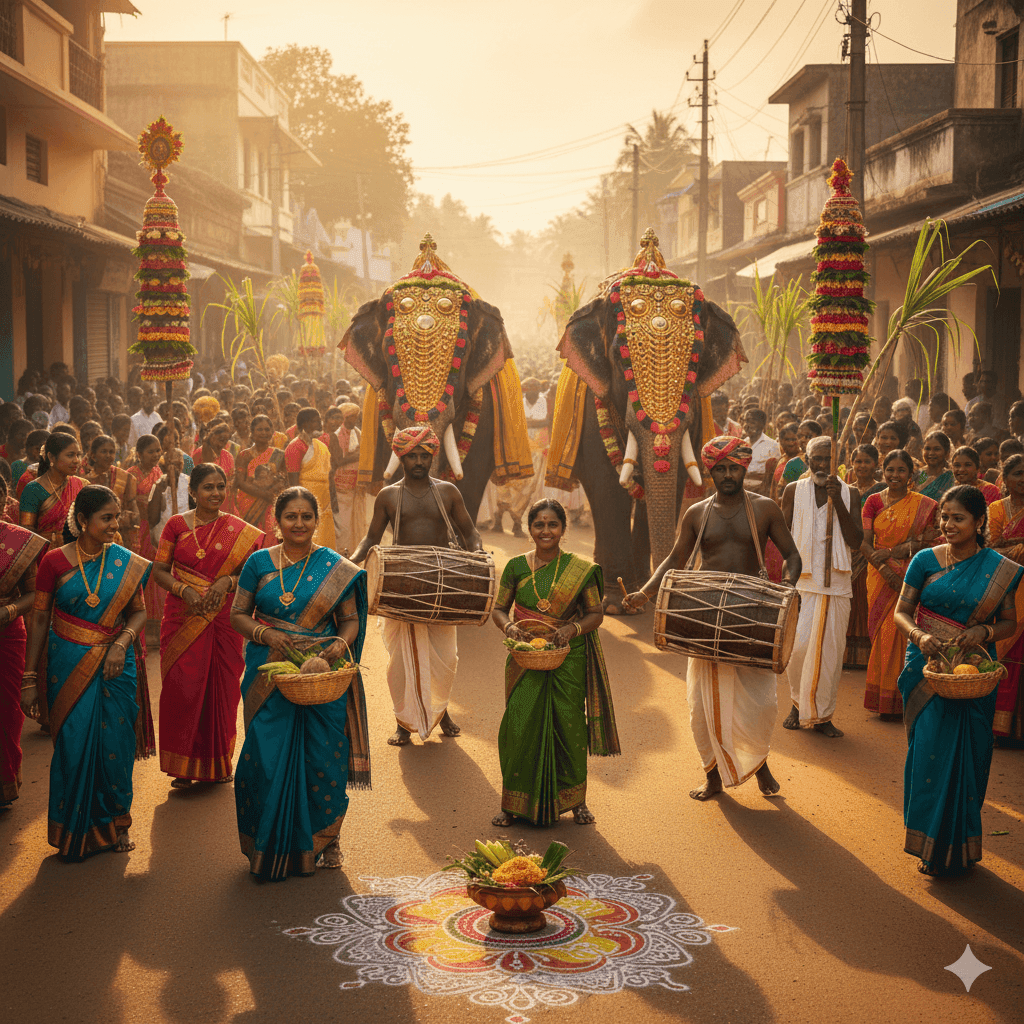
People speak of Kanam pongal the way forest workers speak of signs on a quiet trail. They do not describe the festival with long explanations. They point to hints. A cluster of kolams appears before sunrise. Sugarcane was tied to a doorway that was empty the night before. Women carrying turmeric water toward the street. These signals tell anyone watching that the day of processions has begun, even before the drums start.
Reading the Festival Trail
No one asks why we celebrate Kaanum Pongal during the processions. The answer is already in the movement of people. Families leave their homes in small, quiet waves. Mothers carry rice prepared at dawn. Children hold flowers wrapped in banana leaves. Elder men step onto the street with slow, measured confidence that feels older than the neighborhood they live in. Every gesture forms an unspoken guide on how to celebrate Kaanum Pongal. The street offers clues long before crowds gather. Freshly washed thresholds. Clay lamps were stacked neatly near a gate. A distant rhythm of beats rising and falling as groups organize. These details reveal what the Pongal celebration is without a single word spoken. It is a day built on observation, participation, and inherited knowledge.
Processions That Move Like Memory
The processions begin without an announcement. A drumbeat. A whistle. Then a surge of color. Women in bright sarees walk with baskets of offerings, their steps in tune with the beat. Men follow carrying sugarcane poles, each pole tall enough to brush low-hanging wires. Children walk in clusters, laughing, spinning, and pointing at the decorations hanging from doorways. People do not talk about the importance of the Pongal celebration here. They show it. They move together as if the street itself is guiding them. Each house joins at a different moment, but every group blends seamlessly into the flow. You cannot tell where one procession ends, and another begins. It feels less like a parade and more like the village breathing in one rhythm.

The Rituals Hidden in Plain Sight
If someone asks for pongal celebration ideas, the villagers point to the simplest acts. Touching the river water. Feeding the birds. Sharing rice with neighbors. These actions look small, but they hold the weight of years. They are reminders of why this day exists, why families step out even if the sun is harsh or the path is crowded. On the side roads, women sprinkle turmeric water across the ground. Men tie mango leaves to poles. Children place flowers on small clay idols kept near the junctions. These moments happen quietly, often unnoticed by outsiders. But anyone walking slowly will see that each action is a piece of the celebration that ties the community together.
The Street as a Moving Shrine
The rhythm changes as the day grows. The drums shift pace. The dancers circle wider. Offerings pass from hand to hand. The processions stretch across lanes, then fold back into the central street like streams merging before a river bend. Vendors appear with trays of jaggery sweets. Tea sellers move with the crowd, pouring hot tea into steel tumblers without breaking stride. Small children hand out puffed rice. These gestures create a pulse that keeps the procession alive. No one rushes. No one slows the group. Everyone knows the tempo instinctively.
When Evening Settles
By late afternoon, the processions soften. The colors remain bright, but the pace slows. People sit near temple walls, talking quietly. Others share leftover rice from their baskets. Children run through the fading sunlight, still carrying sugarcane pieces they received hours earlier. The signals of ending look just like the signals of beginning. Lamps dimming. Turmeric water is drying on the ground. Drums lowering to a gentle heartbeat. People stepping back into their homes with the same steady calm they showed in the morning. The day closes the way it opened, with no grand finale, only signs that the ritual has completed its circle. These signs are the language of Kanam Pongal, spoken without words and understood by anyone willing to watch closely.









