
5 Indian Villages That Prove Humans and Wildlife Can Truly Coexist
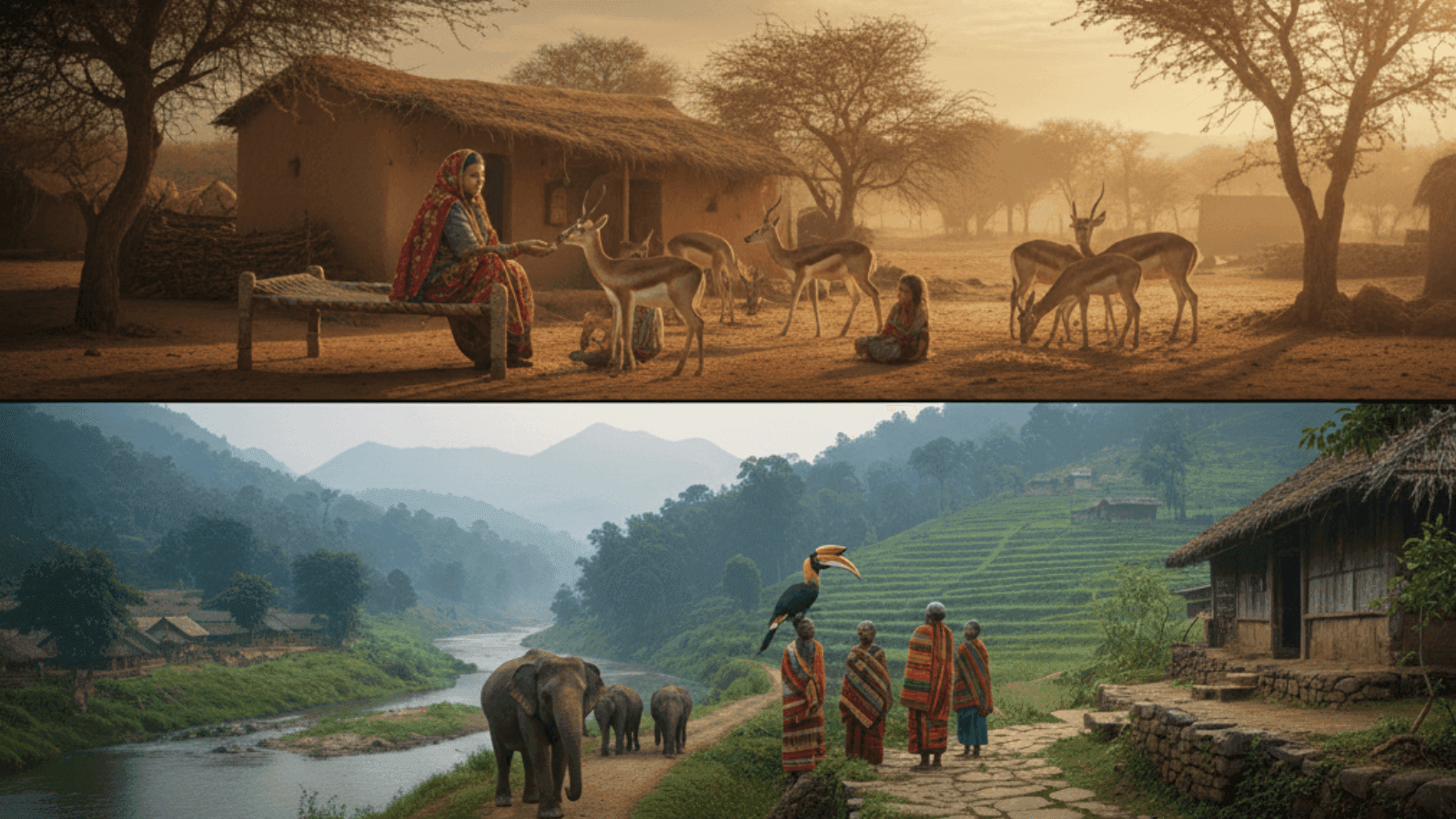
A blackbuck lowering its head to drink from a farm irrigation channel is an everyday sight in parts of Rajasthan.
- Spiti Valley, Himachal Pradesh
- Location: Cold desert of Himachal Pradesh
- Wildlife: Snow leopard, ibex, blue sheep
- What’s special: Spiritual beliefs reshaping predator relations
Spiti’s stark landscape hides one of the world’s most elusive predators. Snow leopards once faced retaliation for livestock loss. Buddhist teachings in the region emphasise non-violence toward all beings, a philosophy that slowly reshaped responses. Villages like Kibber and Langza participate in community-led tourism and conservation programs. Sightings are rewarded. Livestock losses are offset through shared schemes. The snow leopard becomes an asset rather than a threat. Monasteries reinforce the idea that survival does not require domination. At this altitude, coexistence is not romantic. It is necessary.
2. Mawlynnong, Meghalaya
- Location: East Khasi Hills, Meghalaya
- Wildlife: Butterflies, birds, insects, small mammals
- What’s special: Sacred groves protected by community consensus
Mawlynnong is known for its spotless lanes, but the real discipline lies in how nature is treated. Khasi traditions protect sacred groves where hunting, logging, and disturbance are strictly prohibited. These forest patches act as biodiversity shelters maintained without guards or fences. Homes are surrounded by flowering plants that attract insects and birds. Butterflies are common, not rare. Villagers sweep streets daily, yet they also avoid disrupting even the smallest forms of life. Nature is not beautified for visitors. It is preserved for continuity. Tourists are gently reminded not to pluck flowers or chase animals. Conservation here does not announce itself. It survives because restraint is habitual.

3. Khonoma, Nagaland
- Location: Kohima district, Nagaland
- Wildlife: Hornbills, barking deer, civets, butterflies
- What’s special: India’s first community-declared no-hunting zone
Khonoma was once a hunting village. In 1998, residents made a collective decision to stop. Around 20 square kilometres of forest were declared a no-hunting zone, marking a radical cultural shift driven entirely from within. The transition was slow and contested. Elders debated tradition. Younger residents questioned livelihood loss. Over time, the forest responded. Wildlife returned. Bird populations stabilised. Pride replaced resistance. Eco-tourism followed, but it was not the trigger. Conservation here is enforced socially, through shared accountability. Khonoma proves that protection does not always need policy. Sometimes it needs agreement.
4. Bishnoi Villages, Rajasthan
- Location: Western Rajasthan
- Wildlife: Blackbuck, peacock, nilgai, desert birds
- What’s special: Conservation rooted in religious law, not enforcement
In the dry stretches of the Thar Desert, Bishnoi villages follow a code written over 500 years ago. Founded by Guru Jambheshwar in the 15th century, the Bishnoi faith includes 29 principles, many centred on protecting nature. Cutting green trees, hunting animals, or disturbing bird nests is forbidden, not as a suggestion but as a moral rule. Blackbucks move freely through cultivated fields, often grazing close to homes. Farmers lose crops, yet retaliation is rare. Wildlife is not seen as an intruder but as a rightful co-inhabitant of the land. Children grow up learning animal behaviour alongside farming practices, absorbing respect through observation rather than instruction. The story of Amrita Devi, who sacrificed her life in 1730 while protecting khejri trees, is still spoken of as lived memory. Protection here is not symbolic. It is personal, costly, and non-negotiable.
5. Wayanad, Kerala
- Location: Western Ghats, Kerala
- Wildlife: Elephants, wild boar, monkeys, birds
- What’s special: Indigenous knowledge guiding coexistence
In Wayanad’s tribal regions, forests are not borders to cross. They are living spaces shared across generations. Adivasi communities such as the Kurichiya and Paniya have long relied on forest produce, seasonal farming, and sustainable building methods. Elephants frequently move through agricultural land. Wild boars damage crops. Instead of violence, farmers rely on traditional deterrents like smoke signals, fermented fruit traps, and coordinated noise. These methods do not eliminate conflict, but they reduce escalation. Children are taught to identify animal tracks, understand warning calls, and move carefully through shared terrain. Safety comes from awareness, not separation. Even as modern pressures creep in, this knowledge continues to act as a buffer against fear-driven responses.









