
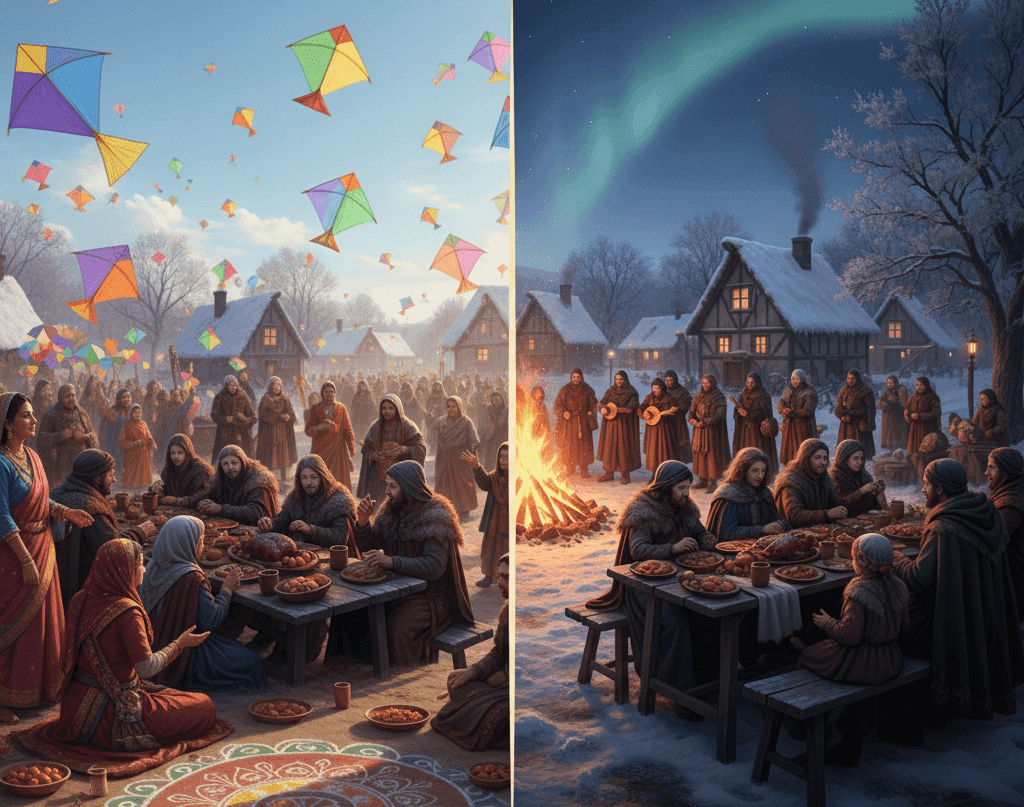
Solar turn celebration begins with a shift so slight that most people never notice it directly. Birds sense it first. Farmers feel it in the soil. Priests mark it on old calendars. In India, this moment carries names like Uttarayan and hints of the coming harvest, but the same turning of the sun appears quietly in other cultures that never exchanged rituals or stories.
The Moment the Sun Changes Direction
Communities that follow the sky more closely than clocks treat the solar turn celebration as a correction in the rhythm of the world. They say it is the day the sun begins its northward journey. In Gujarat, people link this moment to Uttarayan 2026 and prepare for the light that will grow longer each week. In old Sanskrit texts, this shift is described through Uttarayan and Dakshinayan, two halves of a cosmic breath.
When people ask what the period of Uttarayan is, elders explain it simply. The northward movement is not a single day but a season that stretches until the monsoon heat begins to rise. The day itself is a marker, a doorway, a signal. Farmers read the shift through crop behaviour instead of calendars. Fishermen read it through changes in wind direction.
In other parts of the world, similar shifts exist without the same vocabulary. Nordic communities watch the first stretch of daylight after long darkness. East Asian cultures observe subtle ceremonies linked to sunlight returning. Words differ, but the instinct is identical.
How Harvest Beliefs Follow the Sun
The Uttarayan harvest festival in India is one expression of this turning. Seeds, sunlight, and timing align. However, the idea that a harvest cycle begins with a shift in light is found in places that have never heard of Uttarayan. In the Andes, farmers greet the longer days with offerings to mountain spirits. In rural Japan, people clean shrines to invite favourable planting seasons.
Why Uttarayan is celebrated on 14 January is often explained through astronomical adjustments. The date holds steady for cultural consistency, even when exact alignment shifts slowly over centuries. The choice is less about numerical perfection and more about shared meaning. A day that communities can recognise together becomes stronger than a calculation.
People in Western agrarian societies once marked similar solar turning points with midwinter feasts. They celebrated endurance, the promise of spring, and the certainty that darkness would not win. They never used the word Uttarayan but responded to the same celestial tilt.

Kites That Rise With the Sun
Gujarat turns the solar moment into a sky ritual. During the kite festival, Rann of Kutch 2026, bright paper triangles rise against pale winter sunlight. People say they are sending the first message of the new sunward season. Children chase shadows. Adults pull strings with the seriousness of sailors reading the wind.
In some villages, the morning of Uttarayan begins with silence. They watch the horizon before the first kite is launched. When the sun edges up, the colours return. The sky becomes a reminder that this shift is not just astronomical but emotional.
Other cultures celebrate the turning of the sky differently. In Mongolia, people hang new wind flags. In Mediterranean towns, windows are opened early so the first light enters without resistance. These gestures echo India’s kite ritual, though shaped by different climates and history.
The Shared Instinct Across Continents
Every culture that lives close to land or sea eventually forms a ritual around the solar turn. They may not name the moment, but they feel it. They may not connect it to Uttarayan 2026, but they sense the sun’s direction changing. They respond with kites, feasts, prayers, or silence.
Solar turn celebration becomes a map of human intuition. A tilt in the Earth’s axis creates a tilt in behaviour. People gather. They honour the coming season. They read the light as their ancestors once did. And they treat this shift not as a date but as a signal, subtle yet powerful, that the world has begun to turn again.









