
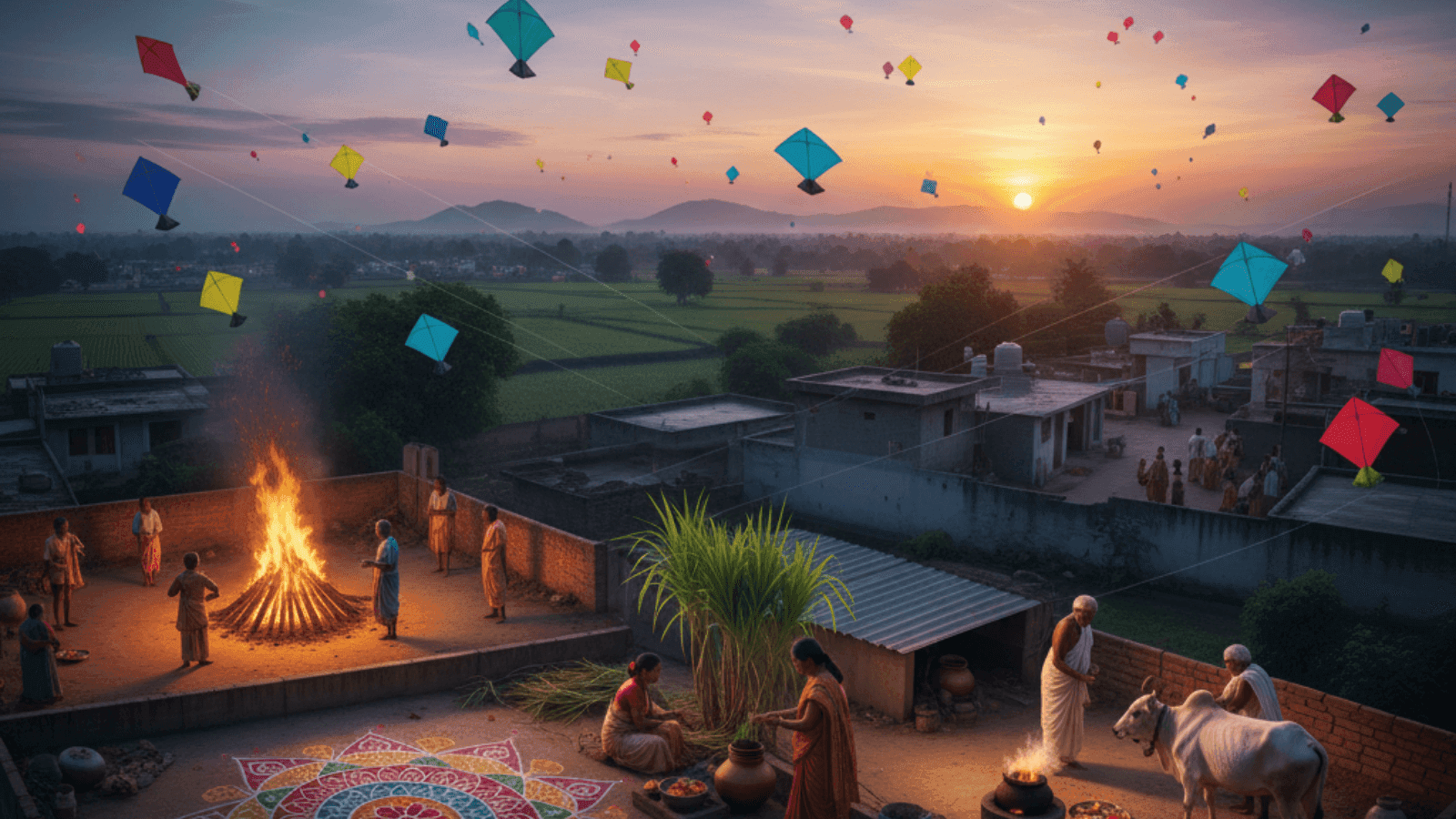
How India Looks on Sankranti Morning Before Breakfast
Sankranti mornings move on muscle memory. Rooftops gather kites, river steps fill with quiet footsteps, and cows are washed while the air still holds winter chill. By the time hunger arrives, half the festival has already passed through the house.
North India: Cold Water, Warm Fires, Quieter Streets
Riverbanks Before the First Tea
In Uttar Pradesh, Uttarakhand, and parts of Bihar, movement starts near rivers, not homes. At the Ganga, Yamuna, and their smaller tributaries, people arrive wrapped in shawls, steel lotas tucked under arms. The water is sharp enough to make breathing pause for a second. Dips are quick, deliberate, repeated only if necessary.
Priests stand waist-deep, calling out mantras without ceremony. Someone always forgets a towel. Someone else offers one without looking up. By the time tea stalls heat their kettles, most bathers are already leaving, hair wet, fingers numb, expressions settled.
After Lohri, the Ashes Remain
In Punjab and Haryana, the loudness belongs to the previous night. Morning finds courtyards with dying embers and scattered peanut shells. The bonfire space is treated carefully. Ash is not swept away immediately. A small offering is placed, touched, removed.
The streets stay quieter than usual. Children who danced late are still asleep. The festival energy lingers, but it moves slower now, wrapped in winter fog.
West India: Rooftops First, Kitchens Later

Gujarat’s Sky Prepares Itself
In Ahmedabad, Surat, Rajkot, and smaller towns, rooftops wake up before families do. Plastic chairs, bricks, and water buckets mark territory. Kite strings are tested against calloused fingers. Someone checks the wind by throwing scraps of paper into the air.
The first kite goes up silently. No shouting yet. Radios play old songs because nobody wants to break focus. Thermoses of tea arrive quietly, carried up by younger siblings.
By sunrise, the sky is already crowded, but the competition hasn’t begun. Morning is for setting up, not winning.
Maharashtra’s Sweet Start
In Maharashtra, kitchens wake before rooftops. Sesame seeds roast early, filling houses with a smell that signals Sankranti more clearly than calendars do. Til-gud laddoos are shaped quickly while the mixture is still warm. Fingers burn slightly. Nobody comments.
Outside, rangolis are drawn before traffic exists. Rice flour sticks to damp ground. Designs are confident, unmeasured, meant to fade. Women exchange sweets briefly at doorways, not lingering. “God god bola” is said softly, almost automatically.
South India: Cattles, Rice, and the Order of Things
Tamil Nadu’s Morning Belongs to Cows
In villages across Tamil Nadu, the first water of the day is not for people. Cows are bathed slowly, thoroughly. Horns are scrubbed and painted. Bells are cleaned. Sugarcane stalks are placed nearby, uncut.
Kolams appear first at cowshed entrances, then at the main door. Children are told to keep distance. A restless cow can kick, and today, patience matters more than speed. Only after the animals are settled do kitchens come alive.
Pongal Pots Before Plates
Pongal pots are washed, decorated, and positioned carefully. Milk is watched closely as it heats. When it spills over, voices rise together, not loudly, just enough to mark the moment. “Pongalo Pongal.” No one eats immediately. The offering comes first. Rice, jaggery, ghee, cashews, and raisins sit steaming while elders finish prayers. Breakfast waits its turn.
Andhra and Karnataka’s Shared Rhythm
In Andhra Pradesh and Karnataka, Sankranti mornings move between house and courtyard. Rangoli designs stretch wider, often covering entire entrances. Cattle are decorated with turmeric and vermilion. Children run around with sugarcane pieces already chewed halfway.
Kite flying appears later here, after rituals. Morning belongs to land, grain, and animals.
East India: Smoke, Rice, and Community Fires
Assam’s Quiet After Meji Fires
In Assam, Bhogali Bihu mornings are calm after the Meji fires of the night before. Temporary huts stand half-burnt. Smoke lingers low over fields. Community cooking spaces are cleaned slowly.
Rice cakes and freshly harvested grain are handled with care. Nothing feels rushed. The celebration already happened; the morning is about settling back into routine without losing warmth.
Odisha and Bengal’s River Mornings
Along rivers in Odisha and parts of West Bengal, Sankranti begins with water and rice. People bathe quickly, offering prayers to the Sun. Small fairs start assembling later, but early morning stays personal. Vessels clink softly. Feet move carefully on stone steps slick with algae. By the time shops open, rituals are done.
What Ties the Morning Together
- Sugarcane is everywhere. Against doors, near shrines, eaten standing up before breakfast is mentioned. Broken by hand, chewed slowly. No one explains it.
- Clothes are chosen for warmth first. Shawls over silk, sweaters over kurtas, socks under festive wear. Black appears without comment. Comfort wins.
- Sounds overlap without order. Bells, kite spools, cow bells, pressure cookers, stray firecrackers. No single rhythm.
- Talk stays practical. Wind, water, animals, string tension. Phones stay inside.
If you want to wake up to Sankranti mornings like this, not as a visitor but as part of the place, Neomaxer makes that possible. Their stays are rooted in real locations, close to how festivals are actually lived.









