
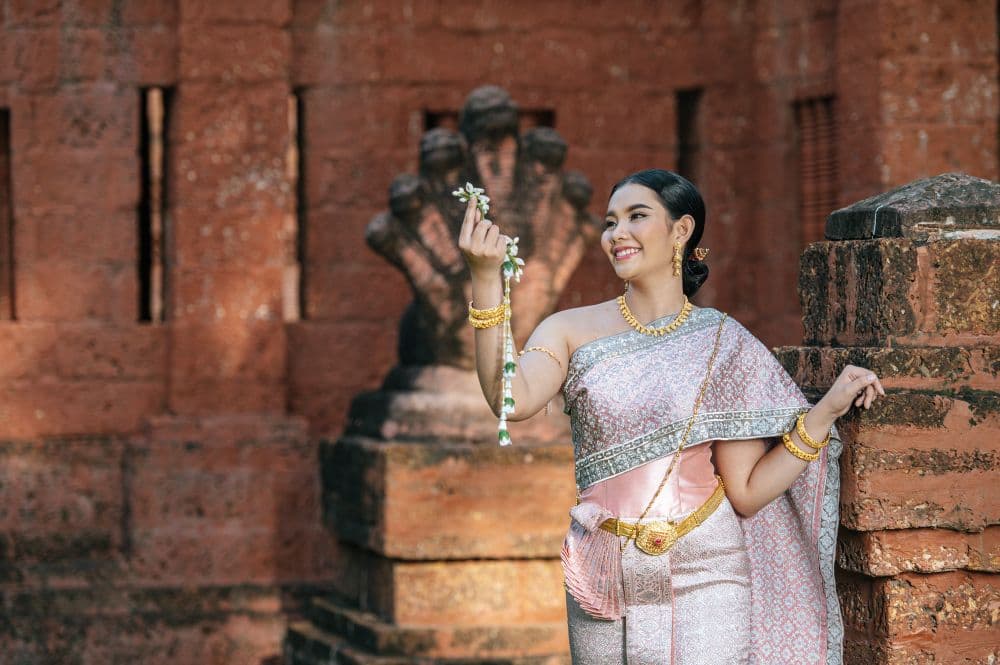
The curve of a dancer’s wrist is not a mere gesture; it is a thousand year old message from the stone walls of Angkor. This is the pulse of "Cambodian heritage" in its most delicate form.
In the dance schools of Phnom Penh, the teachers do not talk about grace casually. They talk about signs. A thumb pressing back against the palm. The precise angle of a heel lifted off the floor. The way a young girl spends years stretching her fingers until they mimic the petals of a blooming lotus. This is not performance. This is a living record of "Cambodian culture and traditions".
The Weight of Gold and Silk
The world looks at the "Cambodia heritage list" and sees the stone temples of Angkor Wat and Preah Vihear. But the "Cambodia unesco intangible cultural heritage" belongs to the movement of the people. The Apsara dance was nearly lost in the dark decades of the twentieth century. Today, it is protected like the ruins it represents. When travelers ask "how many world heritage in Cambodia" exist, they usually count the towers, but they forget the spirits that dance between them.
Symbols in Every Movement
The "national Cambodian heritage museum" preserves the costumes, but the stage preserves the soul. "Cambodian culture facts" reveal that each of the 1,500 hand gestures has a specific meaning. One movement represents the earth. Another represents the water. A third signifies the fruit that comes from the tree. This "Cambodia cultural heritage" is a language that does not need a single spoken word.

Watching the Spirits Wake
You pay your entrance fee in the "Cambodia currency", the Riel, or more commonly in US dollars. The "Cambodia currency" is a tool for the traveler, but the dance is the payment to the gods. You sit in a theater in Siem Reap, and ten minutes later the modern world disappears. Speed drops. Silence increases. Cameras stay ready, but the dancers move so slowly they almost look like the statues in the "national Cambodian heritage museum".
The silk of the costume is heavy, embroidered with threads that catch the orange glow of the stage lamps. The crowns are tall and pointed, mimicking the spires of the ancient city. The dancers breathe in unison with the flutes and the wooden xylophones. This is shared history. It is the shadow of a kingdom that refused to die.
The Training of the Apsara
Training begins in early childhood. It is a physical discipline that reshapes the body. The dancers do not talk about the pain of the stretch. They talk about the results of the discipline. A broken line in the movement is a broken line in the history of the nation. They are the guardians of the "Cambodia cultural heritage" that was once reserved for kings.
You walk out of the theater. The night is warm. The scent of jasmine follows you. The Apsara dance is the most visible sign of "Cambodian heritage" surviving in a modern world. To witness this living art properly, you should book your stay via Neomaxer to find a sanctuary close to the ancient stages of Siem Reap. "Cambodian heritage" is not something you see once and forget. It is a sign you keep seeing in every curved branch and every silent temple doorway.









