
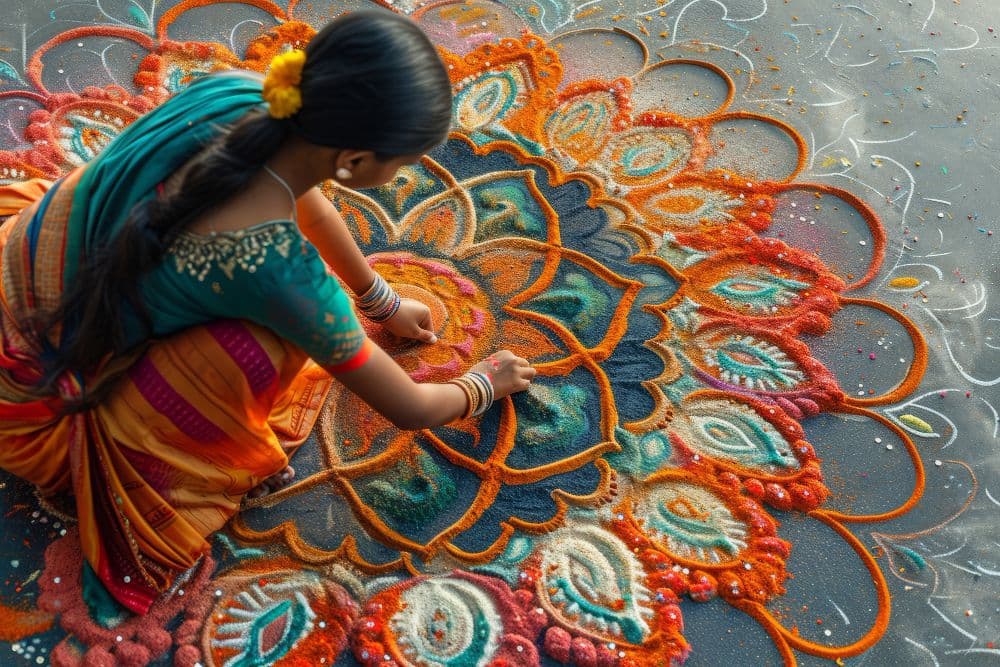
Kolam artists in Tamil Nadu do not sketch. They listen to the ground. Before dawn, women bend over the threshold and create street mandalas from rice flour, the same way trackers read the first prints on soft mud. Each line follows a rhythm older than memory, drawn without hesitation, erased by footsteps, redrawn the next morning as if the geometry breathes.
Learning the Ground Language
A street mandala design begins with dots scattered like seeds. The artist moves around them the way forest guards circle signs on a trail, checking direction, checking intent. Curves wrap around each dot as if avoiding something sacred beneath the soil. Visitors often ask for street mandala ideas, expecting colours or templates, but locals point to the earth itself. Watch how the rice flour falls.
Watch how the border forms. Watch how the pattern grows without measuring tools. The mandala is not a decoration. It is a conversation with land, prosperity, and ancestors who believed symmetry protects the home.
Art That Moves Without Staying Still
Kolams shift through the day. A breeze lifts one corner. A cow nudges another. By noon, the once perfect geometry has softened into dust trails leading toward the street. Elders do not mourn this. They say beauty is not weakened by disappearing.
It is strengthened by returning. At dusk, the ground empties again, whispering the next morning’s pattern. Travelers expecting permanence learn instead to appreciate presence, just as tea estate workers respect signs that last only until the next rain.
Streets Become Galleries Before Sunrise
Walk through a village at 5 AM, and you feel like you stepped into an open-air gallery before the crowds arrive. More than fifty houses display their own interpretations of the old grid. Some look like lotus wheels. Some look like star paths. Some spread so wide they cross the street. Yet no one claims ownership.
No one signs their art. Only the ground remembers who made which pattern. Children watch their mothers create the first few strokes and mimic them on tiny patches of earth, learning geometry without studying numbers.

From Grounded Geometry to Sky Architecture
In Gujarat, the craft rises from soil to sky. The same precision found in kolams flows into paper kites at the 24-hour bazaars of Jamalpur. Artisans sit cross-legged on the floor, bamboo sticks arranged like compass needles around them. One thin strip becomes a spine. Another becomes a wing.
The paper stretches across the frame like a skin that knows exactly how much tension it can carry. They do not speak much while crafting. They test the frame by feel. They test balance by lifting it lightly with fingertips, as if sensing air currents before the sky has even touched it.
Markets That Never Sleep
The bazaar does not close during festival week. Lights stay on. Scissors keep snipping through coloured sheets. Somewhere in the corner, glue simmers over a small stove. Buyers arrive at all hours, searching for the kite that fits their hand the way a story fits a listener. Outside, loudspeakers announce competitions, but inside the workshops, time moves slowly.
Each kite inherits the knowledge of those made before it, shaped by families who have passed down the craft for generations. You watch an artisan transform a plain sheet into a diamond that knows how to climb wind, and the moment feels as sacred as the first kolam line drawn on a quiet village street.
Threads That Connect Ground and Sky
Kolams teach you how geometry protects a threshold. Kites teach you how geometry lifts a prayer. Both belong to landscapes where art exists because life demands it, not because galleries curate it. Travelers who follow these craft routes begin noticing the signs. A basket of rice flour on a veranda means a new pattern is coming.
A stack of bamboo sticks leaning against a shop means night work continues. And if this holiday pulls you closer to these living traditions, staying in neighborhoods where artisans still shape ground and sky becomes essential, which is why booking through Neomaxer helps you remain within walking distance of the next unfolding street mandalas before they disappear again.









