
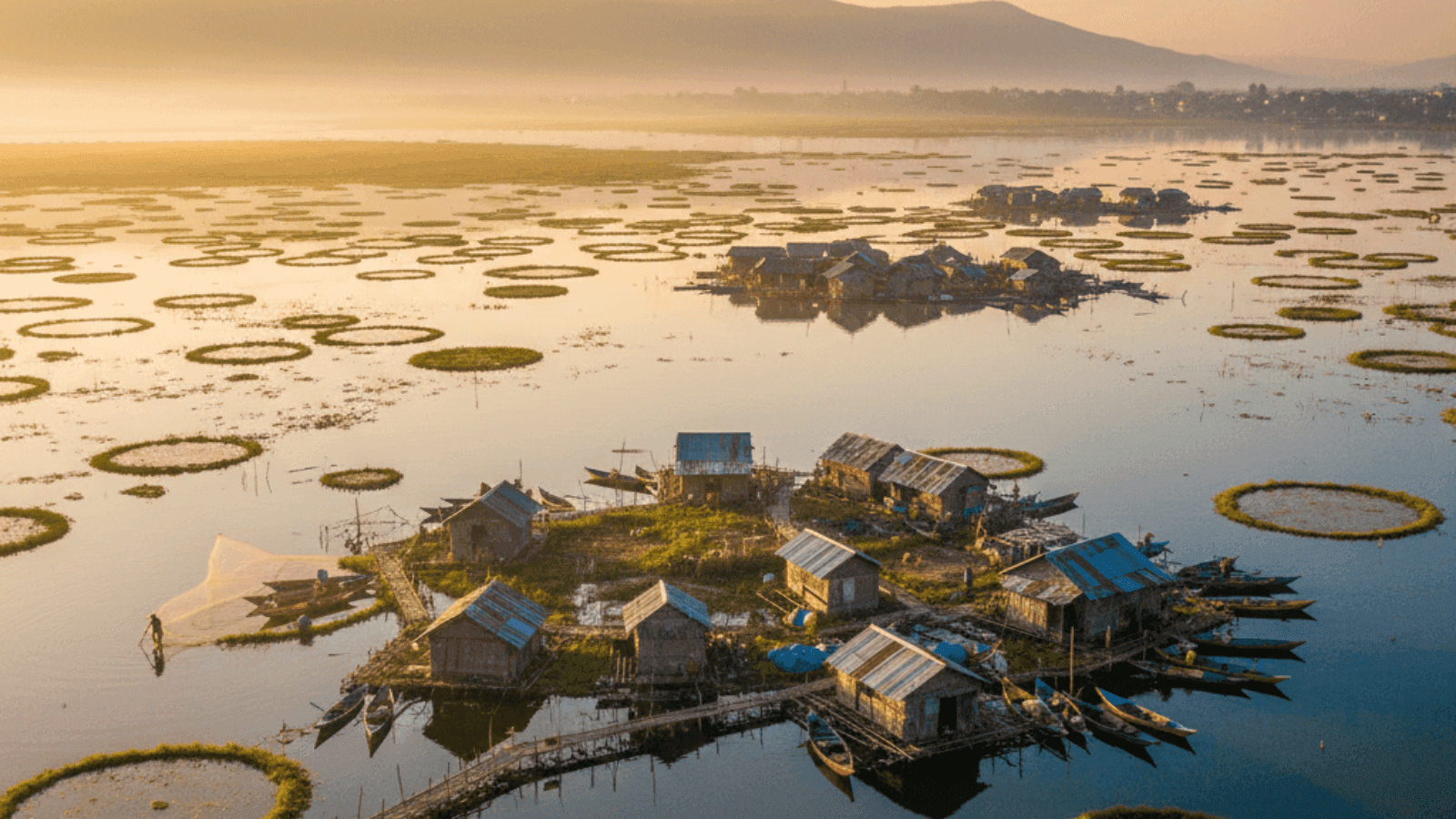
The Floating Town of Manipur Where Roads Don’t Exist
There is no such thing as arriving on foot here. The moment the land ends, the lake takes over, and the rest of the journey happens on water.
Where This Place Actually Is
Loktak Lake lies about 45 kilometres south of Imphal, in Manipur’s central valley. Moirang town is where most travellers reach by road before switching to boats. From that point onward, the idea of streets, crossings, or pavements quietly disappears.
The lake expands and contracts with the seasons, sometimes covering close to 500 square kilometres. What looks like solid land from a distance often turns out to be floating vegetation.
What You’re Really Standing On
The surface beneath the houses is called a phumdi. It is a thick, floating mass made of plants, roots, soil, and decomposed organic matter. Only a small portion stays visible above water; most of it remains submerged.
Some phumdis drift slowly. Others have thickened over decades and can support huts, trees, even entire villages. Locals know which ones are stable and which ones are not, knowledge passed through observation rather than maps.

How People Move Without Roads
There are no roads between villages on the lake. Boats are the only way to get around. Small wooden canoes and motorboats function as taxis, school buses, and delivery vehicles.
Routes are not marked. Boatmen navigate by memory, vegetation patterns, and distant hills. During fog or strong winds, travel slows or stops entirely, and no one seems impatient about it.
Visiting a Village That Floats
Villages like Karang sit entirely on floating land. Houses face the water, not streets. Boats are tied right outside homes, acting as doorsteps.
Walking paths are narrow wooden planks laid across phumdis. Balance matters. Visitors instinctively slow down, matching the careful pace of residents who have learned to read every slight movement underfoot.
What Daily Life Looks Like on the Lake
- Early mornings see fishing boats moving quietly across the water
- Children commute to school by boat instead of buses
- Household chores like washing vegetables and utensils happen right at the lake’s edge
- Fishing structures made from reeds and plants are spread across the water
- Some enclosures follow traditional methods, while others are newer and more commercial
- The lake provides food and income but requires constant adaptation to changing conditions
Food That Comes Directly From Water
Meals here reflect the lake’s ecosystem. Lotus stems, leafy aquatic plants, and fresh fish appear regularly. Singju, a local preparation, combines lake-grown vegetables with fermented fish and herbs. Most ingredients are sourced locally, shaped by what grows naturally on or near the phumdis. Supplies from outside arrive by boat, not trucks.
The Only Floating National Park You Can See
On the southeastern edge of Loktak floats Keibul Lamjao National Park, spread across a massive phumdi. It is the only floating national park in the world.
This park is the last natural habitat of the Sangai, the brow-antlered deer and Manipur’s state animal. Viewing areas sit on firmer ground, offering wide views of wetlands rather than typical forest trails.
What Travellers Usually Miss About Loktak
- Loktak is not built for tourism; there are no promenades, viewing decks, or marked photo points
- Boat rides are informal and arranged through local conversations, not ticket counters
- Overnight stays near the lake are limited and basic, with hygiene standards varying widely
- Many visitors return to Imphal by evening instead of staying on the lake
- What you get in return is direct access to everyday life, not curated or staged experiences
Why This Lake Matters Beyond Travel
Loktak supports close to 100,000 people living in and around its waters. It supplies drinking water, irrigation, and hydroelectric power to large parts of Manipur.
It is also a Ramsar Site, recognised internationally for its ecological importance. The same floating ground that carries homes also holds an entire regional ecosystem in balance.
When the Ground Is Never Fully Still
Phumdis shift. Water levels rise and fall. Familiar routes change without warning. Locals adjust quietly, repairing boats, reinforcing huts, and altering paths. For travellers, this instability is part of the experience. Nothing here feels fixed or staged. The lake decides the rhythm, and everyone else moves along with it.
If places like this make you want to slow down and stay closer to real life, Neomaxer curates stays that let you experience destinations beyond the usual checklists.









