
India’s Only Floating National Park Exists on a Moving Island
Keibul Lamjao Floats on Loktak Lake
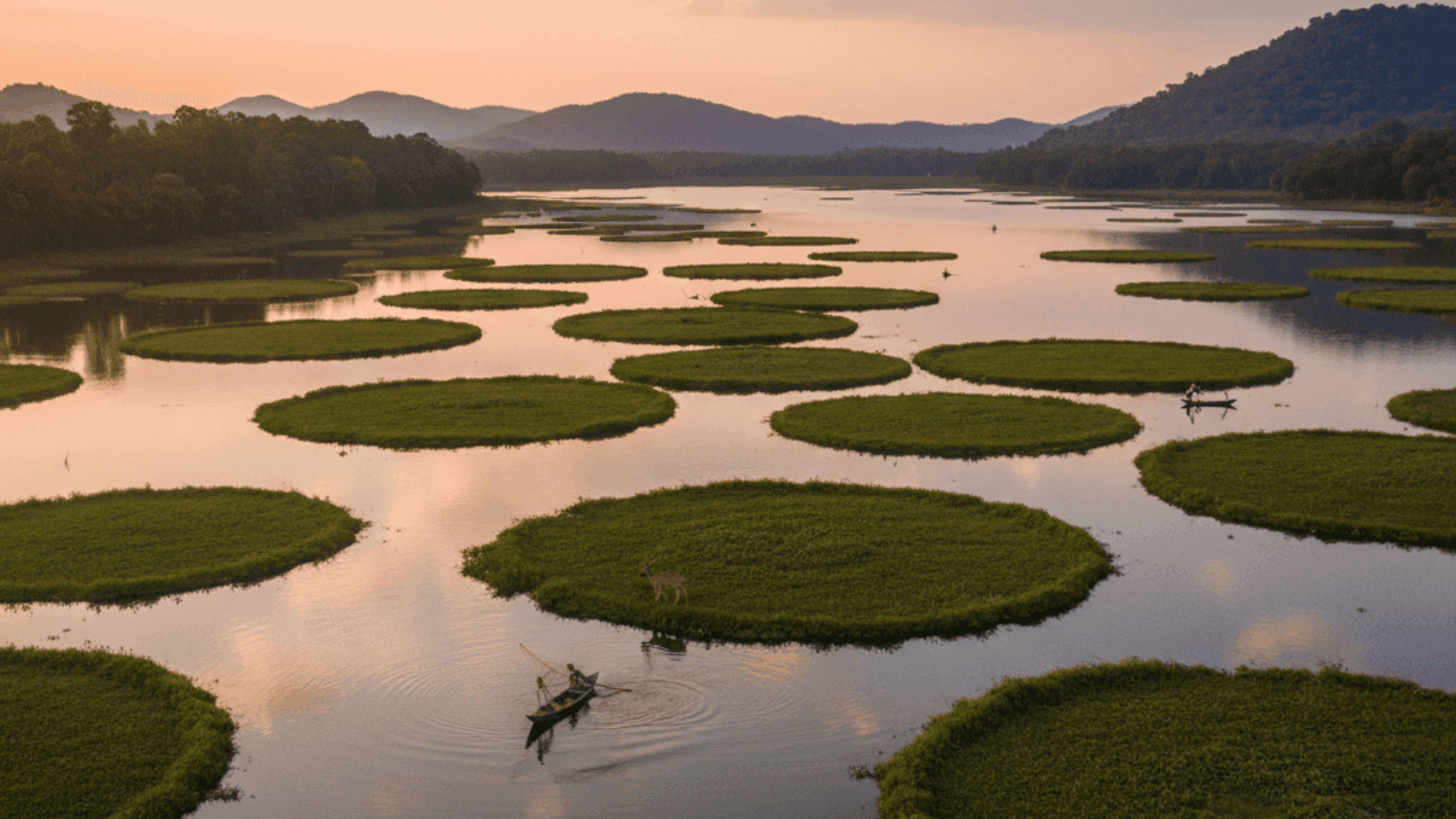
This national park rests on thick floating biomass called phumdis, drifting gently on the surface of Loktak Lake. From a distance, it looks like solid land, covered in grass, reeds, and shrubs. Step onto it, and there is a faint bounce under your feet, like walking on a waterbed disguised as a meadow.
Loktak itself is vast, stretching across the valley with hundreds of floating patches scattered across its surface. Some support huts, some grow vegetables, and one carries an entire protected forest. Satellite imagery studied by NASA Earth Observatory has shown how these floating masses shift shape and position over time, quietly redrawing the map without anyone noticing day to day.
The park covers about 40 square kilometers, but its boundaries are alive. It breathes with the lake.
Phumdis Drift With Wind and Waves
Phumdis are made of decomposed plant matter, soil, and organic debris compacted over years. Some are thin and fragile, others are thick enough to support trees and animals. Their thickness can range from a few centimeters to over two meters.
During the dry season, many phumdis settle closer to the lakebed, absorbing nutrients. When water levels rise, they lift again and drift freely. Wind direction, rainfall, and water currents slowly push them across the lake’s surface.
How to Reach from Imphal
- Start from Imphal, the capital of Manipur, which has the nearest airport with regular domestic flights
- Shared jeeps from Imphal to Moirang run daily, covering about 50 km in roughly 2 hours and costing around Rs 400
- Local buses from Tamei stand to Moirang take about 1.5 hours and cost around Rs 100
- Renting a bike in Imphal gives more freedom, especially for the scenic ride along National Highway 102
- Stop at Sendra viewpoint first, where Loktak Lake opens wide below, dotted with floating islands
- Continue to Naocha Sangai park gate, where boats operate daily into the park

Sangai Deer Spotting Tours
The park exists mainly to protect the Sangai, a rare deer found nowhere else on Earth. It moves carefully across the floating surface, its hooves adapted to balance on unstable ground.
Locals sometimes call it the dancing deer. Each step is slow and deliberate, as if testing the earth before trusting it. Early mornings and late afternoons offer the best chance of spotting one from watchtowers.
Boat rides through narrow channels bring visitors deeper into the floating forest. The sound of water brushing against reeds mixes with bird calls and distant ripples. Even when no animals appear, the silence feels dense and complete.
Packing for Reed Island Walks
- Waterproof shoes or sandals are essential because the ground can be damp and uneven
- Lightweight clothing works best, as humidity rises quickly once the sun is up
- Carry drinking water since shops are limited near the park interior
- A hat and sunscreen help during boat rides, where shade is minimal
- Binoculars make it easier to spot deer and birds from watchtowers
- A small backpack keeps hands free while stepping across narrow floating paths
Lakeside Food
Small food stalls near Moirang and along the lakeshore serve freshly cooked fish curry with rice. The fish often comes straight from Loktak itself, caught earlier that morning. The curry is simple, mildly spiced, and deeply satisfying after hours outdoors.
Some stalls also serve smoked fish, boiled vegetables, and black tea. Seating is basic, usually plastic chairs facing the water. Nothing feels staged for visitors.
How Many Days to Plan
Two days is enough to explore the park, take a boat ride, and watch the lake change color between morning and evening. A third day gives time to ride around Loktak Lake, stop at smaller floating settlements, and watch fishermen balancing effortlessly on moving ground.
If Loktak Lake and its floating national park are calling you, Neomaxer helps you find beautiful stays close to the water and the park gates.









