
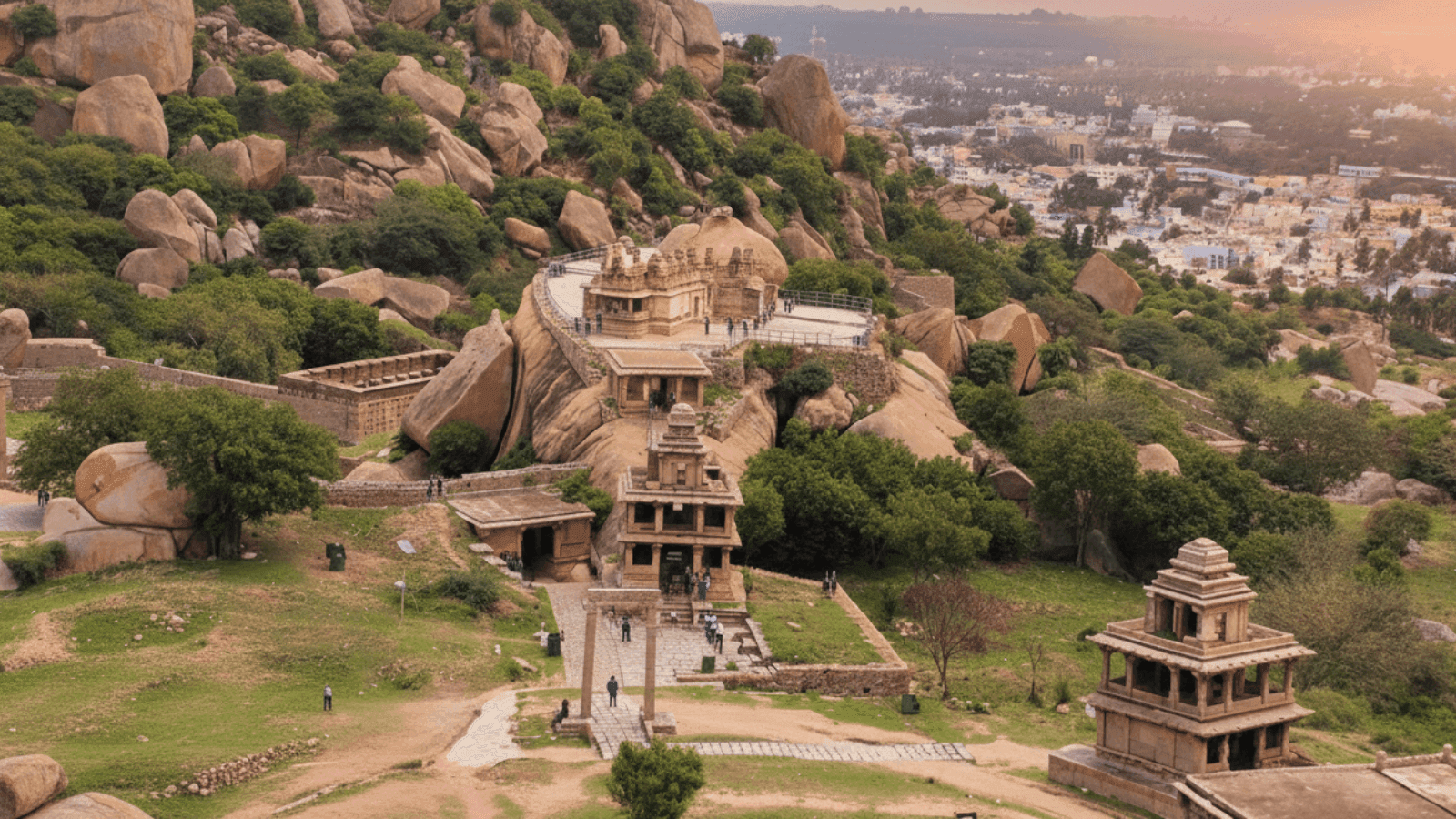
Chitradurga Fort and the Woman Who Stopped an Army
Most forts boast about kings and battles. Chitradurga does something rarer - it remembers a woman who picked up a kitchen tool and changed the course of an invasion. Long before history books noticed her, the fort already had.
Chitradurga Fort, Karnataka
Rising from a landscape of wind-smoothed boulders, Chitradurga Fort feels less constructed and more unearthed. The fort follows the shape of the hill rather than reshaping it, which is why it never reveals itself all at once.
Locally known as Elusuttina Kote, the Fort of Seven Circles, it is built in seven irregular layers that spiral upward across rock faces. Each wall was meant to slow invaders, not stop them outright. Survival here depended on time, confusion, and terrain.
The earliest fortifications date back to the Chalukyas in the 11th century. Hoysalas strengthened it later, but the fort reached its most formidable form under the Nayakas of Chitradurga, who turned it into one of southern India’s toughest strongholds.
Built for endurance, not spectacle
Chitradurga Fort is a lesson in defensive thinking. Gates are offset rather than aligned. Bastions rise where visibility matters most. Even the paths feel deliberately tiring.
There are 19 known gateways, several secret postern gates, and narrow passages that allow movement without exposure. An attacking force that breached one wall immediately came under fire from the next.

Temples inside a battlefield
Hidimbeshwara Temple sits among massive boulders, its presence older than many of the fort walls themselves. Nearby are temples dedicated to Ganesha, Anjaneya, Sampige Siddeshwara, and Gopalaswamy.
The Gopalaswamy Temple stands out for its sculpted Krishna, flute in hand, surrounded by cows and attendants. These temples were not decorative pauses in the fort. They anchored daily life, prayer, and routine within a space built for war.
Onake Obavva
Onake Obavva was not part of the garrison. She was the wife of Kahale Mudda Hanuma, a guard stationed near one such crevice.
In 1779, when Hyder Ali’s forces laid siege to Chitradurga, they chose infiltration over open assault. Soldiers attempted to crawl through the kindi one at a time, planning to open the gates from inside.
A decision made in seconds
While fetching water near the fort wall, Obavva noticed movement and heard unfamiliar sounds. She saw an enemy soldier emerging from the crevice. There was no warning horn. No time to run.
She picked up an onake, a wooden pestle used for pounding grain, and waited. Each soldier who emerged was struck down instantly. The bodies were dragged aside to avoid detection. When her husband returned, the infiltration had already failed.
Obavva died later that day. Some accounts say she was killed during the fighting; others say the shock took her life. What remains undisputed is that her action delayed the attack and altered its course. The crevice is now known as Obavvana Kindi.
Best time to visit Chitradurga Fort
- October to February offers the most comfortable weather
- Day temperatures range roughly between 15°C and 28°C
- Early mornings are ideal for climbing and photography
- Summers can cross 35°C and drain energy quickly
- Monsoons bring greenery but make stone paths slippery
Walking the fort today
The fort is vast and uneven. Exploring it is less about ticking landmarks and more about pace. Paths climb gradually, then steeply. Ruined palaces lie hidden behind thorny vegetation. Granaries, guardrooms, and magazines appear without signage. Some sections demand careful footing, especially near collapsed walls.
Early mornings reveal the scale best. The stone is cool, the light soft, and the fort feels less like a ruin and more like a presence.
What to carry for the walk
- Comfortable walking shoes with good grip
- At least 1–2 litres of water per person
- A cap or scarf for sun exposure
- Light snacks if you plan to explore beyond the main trail
- Phone torch for shaded passages and ruins
Practical tips for travellers
- Start early; the fort is larger than it appears
- Hire a local guide if you want historical context without rushing
- Some areas are overgrown; avoid wandering off marked paths alone
- There are minimal facilities inside the fort, plan accordingly
- Allow extra time if you intend to visit Obavvana Kindi quietly
Chitradurga is often passed on the Bengaluru–Hampi route, reduced to a roadside landmark. Inside its walls, the scale shifts. History here is not carved only in stone, but remembered in a narrow crack where a woman with a pestle decided that entry would not be easy.
If walking through places like Chitradurga makes you want to slow down and stay closer to the story, Neomaxer helps you do exactly that. From thoughtful stays to routes that don’t feel rushed, Neomaxer lets you experience Karnataka beyond quick checklists.









