
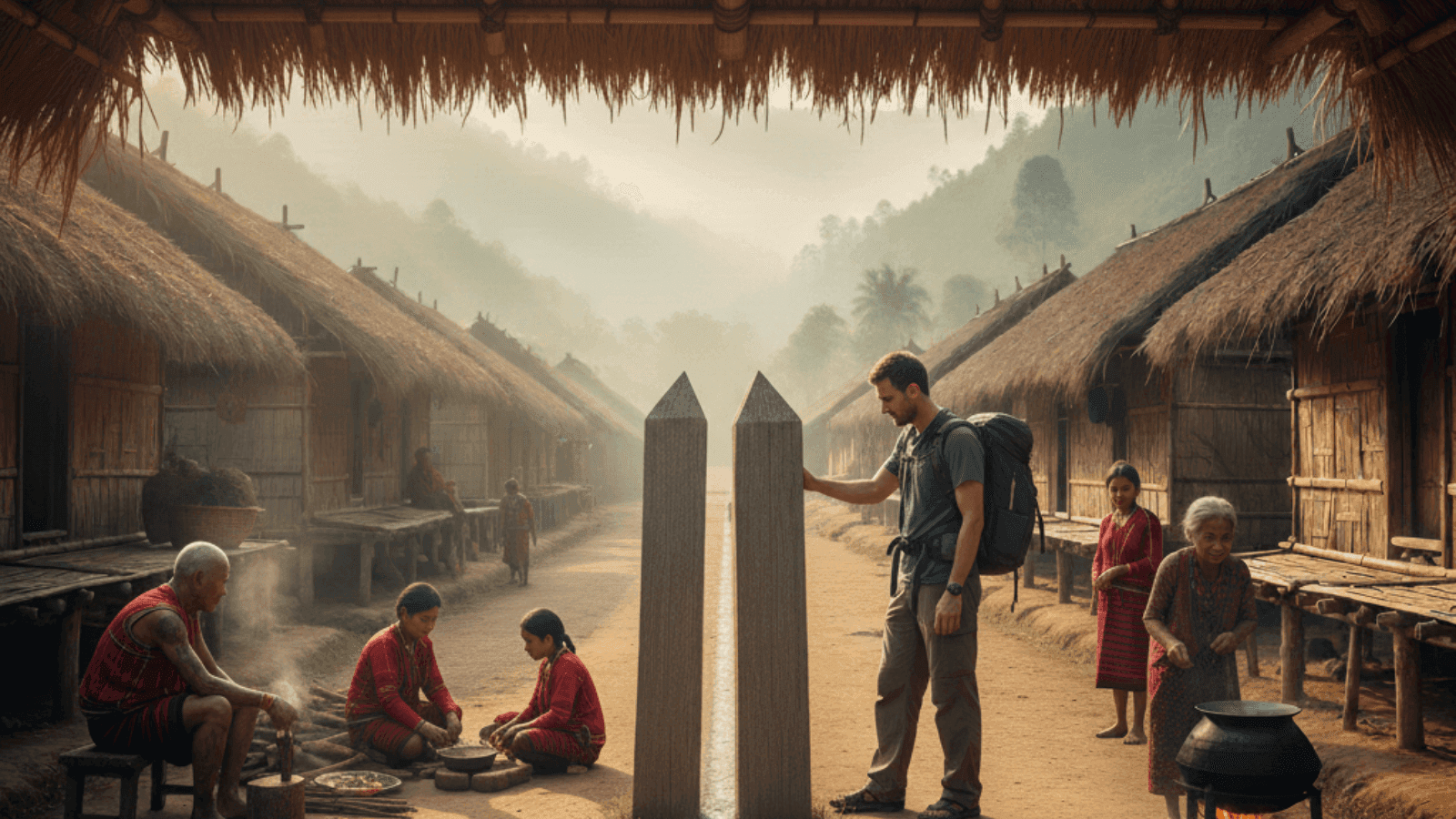
A Border Village Where One House Sits in Two Countries
Some villages sit quietly on maps. Longwa lives right on the line that divides two countries and treats it like part of the floor plan. Daily life continues as rooms, families, and customs flow across it with ease.
Where the map cuts through daily life
Longwa sits high in the Mon district of Nagaland, pressed right up against the India–Myanmar border. The boundary does not run around the village or stop politely at its edge. It passes straight through it. One half of the settlement is in India, the other in Myanmar, and no fence or wall announces the shift.
The most visible marker is a narrow line running across the house of the Angh, the traditional Konyak chief. One room falls in India, another in Myanmar. Visitors often stand with one foot in each country without ceremony or paperwork, while the residents carry on as they always have.
Why Longwa exists this way
Longwa predates the idea of India and Myanmar as modern nation-states. The village existed long before colonial surveys and border commissions arrived in the hills. When the international boundary was formalised in the 20th century, it followed lines drawn on paper, not social or cultural realities.
For the Konyak Naga people, identity has always been tied to clan, lineage, and land, not nationality. The border arrived late and stayed superficial. It divided territory, but not kinship.
Movement without passports
For decades, villagers moved freely across the border for farming, trade, and family visits. Fields lie on one side, homes on the other. Churches, schools, and markets are chosen based on convenience, not nationality.
This was supported by the Free Movement Regime, which allowed border communities to travel up to 16 kilometres across the boundary. Even with recent restrictions and tighter enforcement, daily life still carries the imprint of that openness. The idea of crossing an international border feels administrative, not emotional.

What travellers can and cannot do
- Visitors can move freely within the Indian side of Longwa.
- Crossing into Myanmar is not permitted without official clearance.
- The border is often pointed out casually by locals, sometimes marked by a pillar, sometimes only by shared understanding.
- Standing inside the Angh’s house is enough to grasp the oddness of the place.
- The experience is less about crossing countries and more about noticing how fragile the idea of separation really is.
Food shaped by land, not borders
Meals in Longwa follow the rhythms of farming and season. Smoked pork, rice, bamboo shoots, fermented soybeans, and boiled greens form the backbone of daily cooking. Ingredients come from nearby fields and forests, some technically across the border, others not.
Food is usually shared in homes rather than restaurants. Eating with a host family reveals more about the village than any guided walk.
Festivals and timing your visit
- Aoleang, celebrated in April, marks the Konyak New Year.
- Dances, feasts, and rituals recall older warrior traditions, now remembered as shared history rather than conflict.
- During the festival, the village feels animated, and guests are often welcome to observe or take part.
- October to April is the most practical time to visit, once monsoon rains recede and roads improve.
- Winters can be cool, especially after sunset.
Reaching Longwa
Travel to Longwa takes time and planning. The nearest major access points are in Assam. Jorhat or Dibrugarh serve as common starting points, followed by a long road journey through Sonari and up to Mon, the district headquarters.
From Mon, Longwa lies about 42 kilometres away. The road is narrow, winding, and slow, cutting through hills and smaller villages. Hiring a local vehicle is the most reliable option.
Nearby villages worth the detour
Shangnyu is known for its large stone monoliths, remnants of Konyak history set in open ground. Chui village offers wide hill views and quieter homestays. Veda Peak provides a lookout near the border, often wrapped in cloud.
Each stop adds context to Longwa, showing how the borderland extends beyond a single village.
Conduct that matters here
Photography should always be preceded by permission, especially when elders or ceremonial objects are involved. Certain spaces, such as morungs and ritual areas, are not casual backdrops. Political questions about borders or governance are best avoided.
Respect travels faster than curiosity in Longwa, and visitors are noticed as much for how they behave as for why they came.
The road out of Longwa drops back into forest, and the border line disappears from view long before the village does.
Where travellers stay
Accommodation in Longwa is limited to homestays and simple guesthouses. Comfort comes in the form of warm meals, conversation, and shared space rather than modern amenities. Many travellers choose to stay in Mon and make a day trip, but spending a night in Longwa changes the pace of the experience.
Electricity can be inconsistent. Mobile networks work intermittently. These are not inconveniences so much as reminders of where you are. If places like Longwa spark curiosity about meaningful travel, Neomaxer connects you to stays rooted in culture and calm.









