
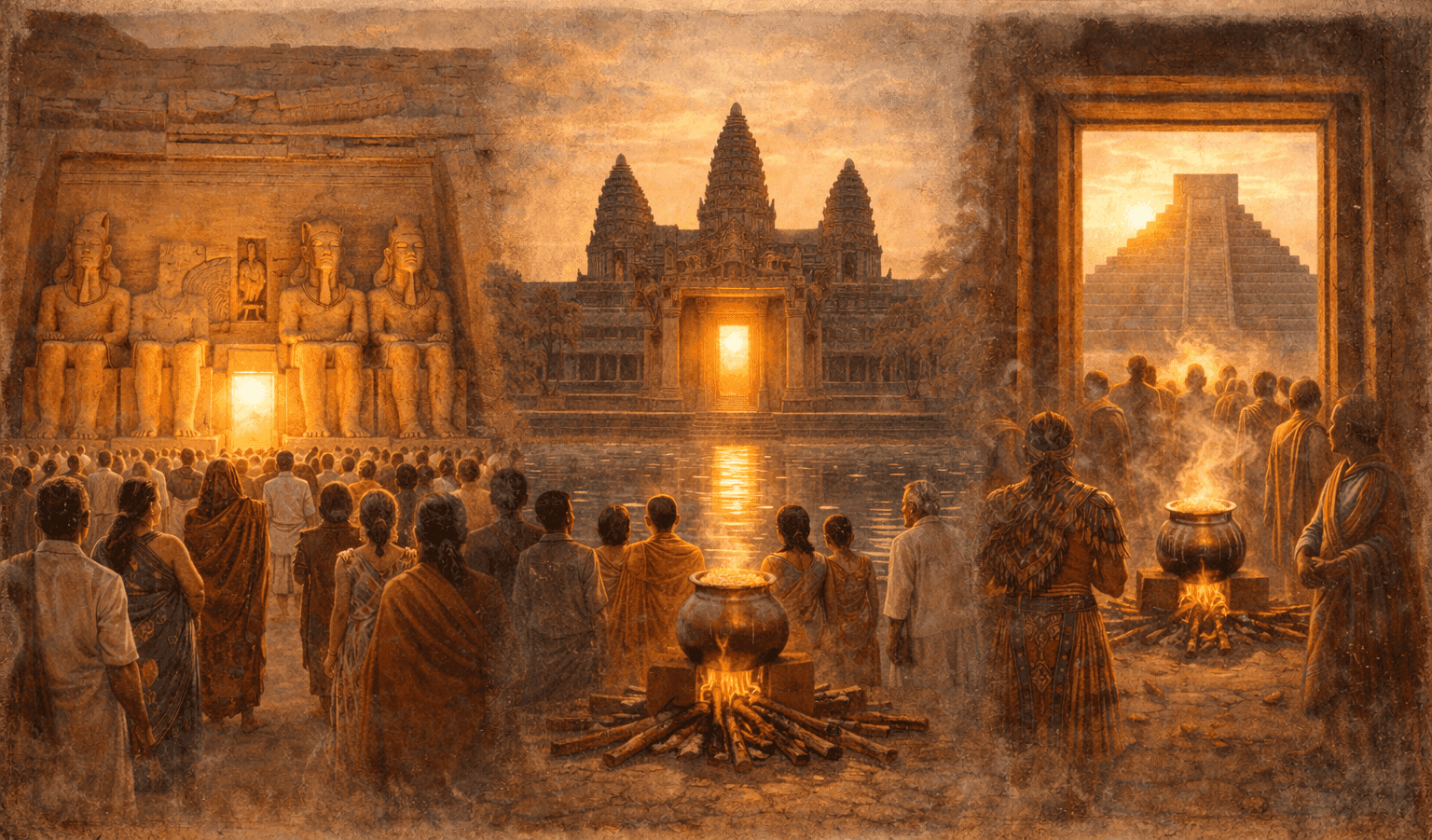
Ancient sun festivals begin with stone, shadow, and the quiet certainty that the sky moves with purpose. Civilizations watched the same sunrise even when oceans separated them. They noticed slants of light entering caves, the way winter shadows stretched longer, the way summer heat arrived with a different colour. These were not coincidences. These were signs.
South America’s Horizon Readers
In the Andes, people stood on ridges before dawn. Not for ceremony, but for observation. Sun pillars, carved stones, and horizon towers told them when seasons would shift. Farmers read these alignments the same way they read cloud patterns or river depth. They had no tools except patience and the instinct to connect light with survival.
The Incas shaped entire cities around the sun. Windows in Machu Picchu catch the solstice like a message passed through stone. Priests once waited for that exact beam, the thin line of gold that confirmed the year was safe to move forward. No chants were needed. They read the sky the way forest workers read broken branches, quietly and without doubt.
Even now, gatherings in these regions echo the old ways. People walk to high places before sunrise, not for spectacle, but to feel that brief moment when the world brightens with intent.
Egypt’s Precision With Light
The heart of ancient sun festivals often beats in Egypt, where temples became instruments of astronomy. Abu Simbel stands as the clearest example. Its inner sanctum waits for the sun to strike the statues inside. Not every day. Only on specific mornings. The rest of the year, the chamber stays in shadow.
People talk about the Abu Simbel sun festival with awe, but those who witness it in person describe something quieter. A hush spreads across the crowd just before light enters the doorway. A single ray slides through the long corridor, touching three statues and leaving one in darkness. That precise illumination is treated like a confirmation of cosmic order.
The Abu Simbel sun alignment is not an accident. It is engineering merged with belief. Ramses II built this place with the confidence that the sun would listen. In Abu Simbel Sun Festival 2026, people will gather again before dawn, staring at the cliff face as if waiting for a secret to open.
Other parts of Egypt share this instinct for reading sunlight. The sun festival Egypt 2026 events planned near temples follow similar rhythms. Not loud. Not crowded. Just people looking at ancient walls to understand something larger than themselves.

Europe’s Stones and Shadows
Stonehenge has become a symbol rather than a living observatory, yet the stones still catch the solstice light with uncanny accuracy. Modern crowds treat it like an event, but the original observers would have stood far quieter, watching the sun slip between the tallest stones with the concentration of someone reading old script.
Across Scotland and Ireland, smaller structures do the same work. Passage tombs that light up only once a year. Stones aligned with the winter sunrise. These are the fingerprints of civilizations that trusted the sky more than rulers or borders. They watched the shadow and light the way mountain guides read wind direction.
East Asia’s Rituals of Recognition
In China, ancient sun festivals tied agriculture to cosmic cycles. The winter solstice was not a celebration. It was a marker. A change in energy. A shift in balance. Families treated the day with seriousness, offering food to ancestors so that the transition of light would favour the household.
In Japan, shrines are often oriented to face the rising sun. Some gates capture the first sunrise of the year perfectly, holding it in the frame for a few minutes before it slips upward. Monks still sit in silence, watching that moment as if receiving instruction.
Before Borders, Before Separation
Civilizations thousands of kilometres apart recognized the same signs. They watched sunlight touch stone at angles that mattered. They built monuments around a moving sky. They listened to the dawn the way forest workers listen for rustling in the undergrowth.
Ancient sun festivals survive because the sky still behaves exactly as it did for them. No border interrupts the path of sunrise. No calendar changes the tilt of the Earth. And somewhere, in deserts, valleys, forests, and mountains, people still gather before dawn to watch the same quiet beam of light that guided the earliest watchers of ancient sun festivals.









