
Senso-ji Temple
About
Senso-ji is Tokyo’s oldest and most visited Buddhist temple, founded in 645 and dedicated to Kannon, the Bodhisattva of compassion. According to legend, the deity’s statue was discovered in the Sumida River by two fishermen brothers who were unable to return it to the water. Today, Senso-ji remains one of the most important places to visit in Tokyo, deeply rooted in the city’s history and spiritual life. The current main hall (hondo) dates to 1958, rebuilt in reinforced concrete after the original structure was destroyed during World War II air raids, while preserving the traditional architectural style. Visitors first pass through the iconic Kaminarimon (Thunder Gate), marked by its massive 700 kg red paper lantern, then continue along the 250 meter Nakamise-dori shopping street. This lively stretch is lined with around 90 stalls offering traditional snacks such as ningyo-yaki, agemanju, and senbei, along with souvenirs like yukata, folding fans, and kanzashi hairpins. The path leads through the inner Hozomon gate into the temple courtyard, where the striking 53 meter five story pagoda stands beside the main hall, making Senso-ji a highlight of Tokyo tourism.

Highlights
What makes this place special
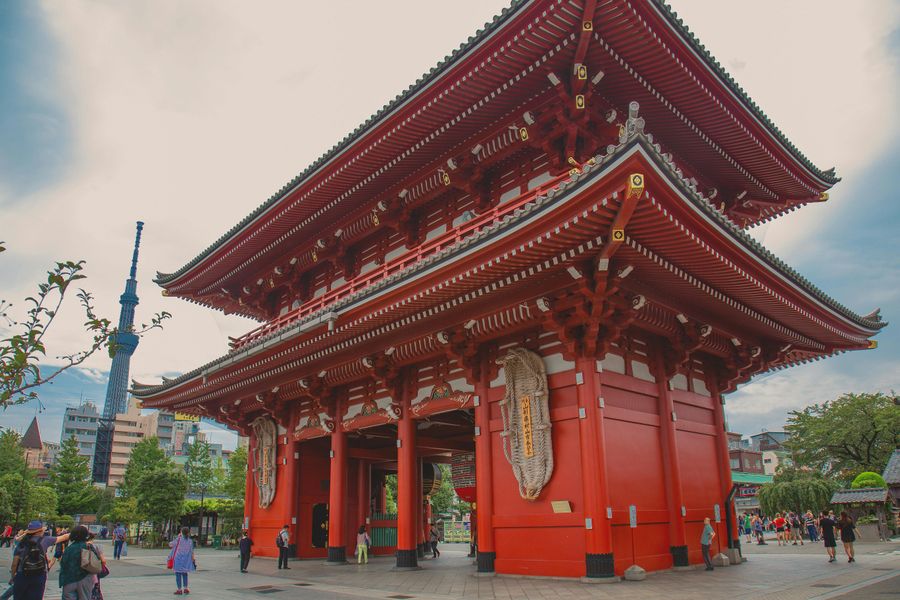
Kaminarimon Gate
The Kaminarimon is an 11-meter-tall red entrance gate at Senso-ji, instantly recognizable for the massive 700 kg red paper lantern suspended at its center. It is the most photographed temple gate in Japan and one of the most iconic places to visit in Tokyo, drawing crowds throughout the day. Arriving early, around 6–7 AM, is the best way to capture a clear view before the crowds build, making it one of the most strategic things to do in Tokyo for photography. As a key symbol of Tokyo tourism, this gate marks the dramatic entrance to the temple complex.

Five-Story Pagoda
The 53-meter vermillion pagoda in the Senso-ji temple courtyard is the second-tallest five-story pagoda in Japan and a standout feature of the complex. It is best photographed from the Hozomon Gate side, where it aligns perfectly with the main hall, creating one of the most balanced and striking compositions among*places to visit in Tokyo. Capturing this view is considered one of the classic things to do in Tokyo, especially for those interested in architecture and traditional aesthetics. As part of the broader temple grounds, the pagoda remains a key highlight of Tokyo tourism.
Things to Know
- •Free entry, donations welcomed
- •Main temple grounds open 24/7 (hondo 6 AM to 5 PM)
- •Nakamise-dori shops 9 AM to 7 PM
- •Go at sunrise for empty Kaminarimon photos
- •Draw an omikuji fortune (100 JPY); tie unfavorable ones to the rack